
Roundtable at European Parliament explores how due diligence can advance Living Income for smallholder farmers and self-employed workers
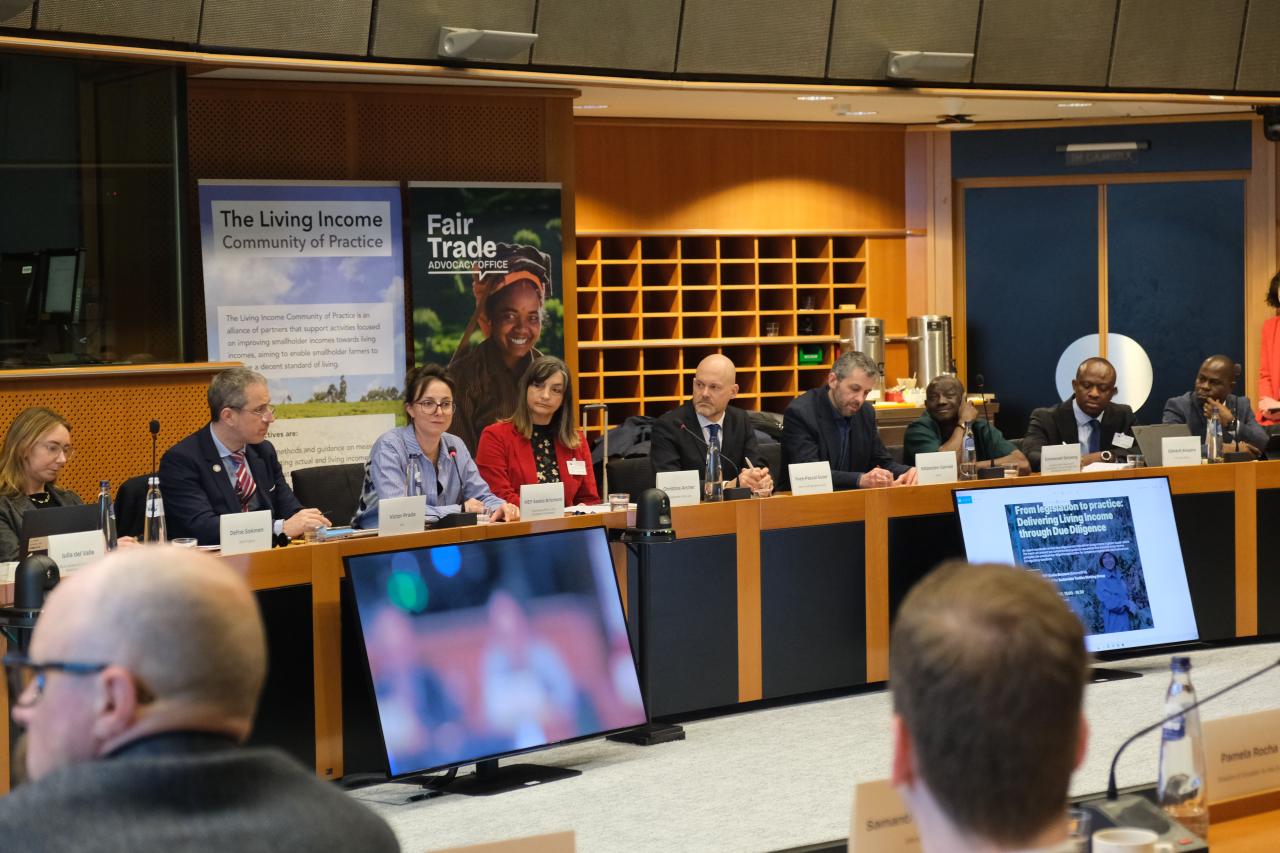
The event brought together 50 participants, including senior representatives from international organisations, European Union institutions, EU Member State governments, specialised agencies of the United Nations, companies, producer organisations and civil society, and was hosted by MEP Saskia Bricmont (Greens/EFA) with the support of the European Parliament’s Sustainable Textiles Working Group.
The roundtable underscored the growing recognition that creating the conditions for smallholder farmers and other self-employed workers to earn a living income is central to responsible business conduct and to the effective implementation of mandatory human rights due diligence internationally and in the EU. Speakers highlighted that without explicit attention to a decent standard of living, due diligence remains a procedural exercise rather than a driver of real change for smallholder farmers and other self-employed workers in global supply chains.
EU Member state representatives shared insights on the importance of harmonised approach to implementing the Corporate Sustainability Due Diligence Directive (CSDDD) - the first legislation globally to enshrine a binding right to a living income - particularly as Member States prepare to transpose the directive into national legislation in the coming years.
Yves-Pascal Suter, Global Head Social Impact, Sustainability at ofi (Olam Food Ingredients) reflected on the practical challenges companies face in translating due diligence obligations into meaningful improvements for producers and the need for policy guidance that recognises the contextual nature of living income gaps. He noted the importance of enabling continued investment in the most challenging supply chains and strengthening multistakeholder collaboration to drive improved income trajectories over time.
In his closing remarks, Emmanuel Sarpong, President of the Asunafo North Cooperative Farmers Union and President of the Fair Trade Ghana Network, underscored the lived realities of cocoa farmers and the structural barriers that continue to prevent farming households from earning a living income. “Farmers need fair prices that can sustain them and their families,” he emphasised. Emmanuel Sarpong stressed that due diligence processes will only deliver meaningful change if they translate into concrete improvements in pricing, purchasing practices, long-term relationships and investments that enable farmers to secure sustainable livelihoods.
The roundtable also marked the publication of two complementary guidance documents designed to address the limited practical support available to companies on integrating living income considerations into risk-based due diligence. The first, Technical Guidance on Living Income Due Diligence has been developed by the Living Income Community of Practice (LICOP) with the support Deutsche Gesellschaft für Internationale Zusammenarbeit (GIZ) GmbH and UK International Development from the UK government, and is intended to guide companies in implementing risk-based human rights due diligence on living income in line with the United Nations Guiding Principles on Business and Human Rights.
The second, Guidelines for a Living Income: Fair recommendations for Living Income Guidance in the Corporate Sustainability Due Diligence Directive has been developed by the Fair Trade Advocacy Office (FTAO) and designed to serve as a resource for the European Commission and regulators in understanding legal compliance expectations under the CSDDD, the EU’s mandatory human rights due diligence requirements as revised in 2025. This initiative is also supported by Deutsche Gesellschaft für Internationale Zusammenarbeit (GIZ) and the Sustainable Agricultural Supply Chains Initiative (SASI).
In her intervention, MEP Saskia Bricmont, who hosted the event, praised the groundwork laid by the Living Income Community of Practice and the Fair Trade Advocacy Office in developing practical recommendations for integrating living income into due diligence processes. She stressed that the FTAO’s Shadow Guidance Document, which sets out clear expectations aligned with the CSDDD, “remains relevant despite recent amendments to European legislation.” She further highlighted that “even though living income and decent pricing are key, I welcome the comprehensive approach, which looks at many concrete direct and indirect aspects and emphasises sector-specific issues.” MEP Bricmont encouraged the European Commission “to take this into account when establishing its own guidelines, as provided for in the Directive,” and called on all companies, not only those within the scope of the legislation, to align their practices accordingly.
Participants welcomed these resources as timely contributions to companies’ due diligence toolkits and to ongoing policy developments at both the international and EU levels. While recent political agreements have narrowed the scope and adjusted some provisions of the CSDDD, the EU continues to expect meaningful action on living incomes. Stakeholders from across sectors – including companies – expressed strong commitment to advance this agenda. The discussion underlined that continued dialogue among policymakers, companies, and producers will be essential to ensure that due diligence effectively translates into tangible improvements in living income for smallholder farmers and self-employed workers.
This publication has been produced with the support of the Sustainable Agricultural Supply Chains Initiative (SASI) and Deutsche Gesellschaft für Internationale Zusammenarbeit (GIZ).

