Joint letter: 50 organisations demand a future-proof Public Procurement Act
Dear EVP Séjourné,
Dear EVP Ribera,
Dear Commissioner Hoekstra,
Dear Commissioner Dombrovskis,
Dear permanent representations,
Cc: Henning Ehrenstein, DG GROW
Every day, more than 250,000 public buyers make decisions that determine how taxpayers' money is spent across critical sectors – from construction to healthcare to food. Those decisions – representing EUR 2.5 trillion annually or 16% of EU’s GDP – shape which products and technologies are rewarded across the Single Market.
Amid intensifying global competition and environmental challenges, public procurement can strengthen the bloc’s competitiveness, promote resilient and responsible supply chains and accelerate the transition to a climate-neutral economy.
That is why 51 organisations across industry, civil society, and public buyers are calling on the European Commission to put forward a Public Procurement Act that secures strategic, resilient and value-based procurement.
Procurement rules that currently predominantly award public contracts to the lowest-priced bid are outdated and no longer sufficient to achieve Europe’s strategic objectives. They risk locking in assets of poor quality that are harder to maintain and more expensive in the long run.
Strategic public procurement allows governments to deliver far greater resilience and competitiveness while accelerating decarbonisation and supporting Europe’s clean industrial transition.
The outcome of the most recent public consultation confirmed it: public spending must be turned into strategic value creation – for citizens and businesses. To do that, the Public Procurement Act must:
- Require public buyers to systematically assess offers based on best value, including quality and innovation, lifecycle costs, environmental (e.g. energy, circularity and relevant externalities) and social performance. Where this is not practicable, procurers should justify their focus on the cheapest bid.
- Deliver a straightforward, mandatory toolbox to drive efficient implementation, including robust labels5 and whole lifecycle costing methodologies, alongside enabling sectoral legislation to set minimum mandatory criteria in key sectors,
- Empower local and regional authorities to act as launch customers: with 45% of the EU procurement procedures managed by sub-national authorities, the Public Procurement Act should strengthen the professionalisation, guidance and capacity of public procurers at all levels of governance.
The proposed Industrial Accelerator Act represents a first, albeit modest, commitment to speed up the creation of lead markets in the EU. However, it does not and cannot compensate for shortcomings in the existing procurement framework. Without a set of procurement rules that systematically reward quality and long-term value, its impact will remain limited.
We urge policymakers to deliver a Public Procurement Act that restricts price-only awarding and rewards best performers, while equipping public buyers with tools and capacity to implement rules effectively.
Aligning procurement policy with Europe’s broader objectives – as defined in the political mandate of the Clean Industrial Deal – is essential to ensure that public investment delivers lasting benefits for the economy, society and the environment.
We would welcome the opportunity to discuss our recommendations further and explore a path forward together.
Signatories:
- Association of Cities and Regions for sustainable Resource management (ACR+)
- Alliance for Low Carbon Cements and Concrete (ALCCC)
- Amfori
- Animal Advocacy & Food Transition
- Autodesk
- Bellona
- B Lab
- Bouygues Europe
- Buy Better to Build Better Coalition (BBBB)
- C40
- Carbon Management Europe
- Clean Air Task Force (CATF)
- Climate Group
- CO2 Performance Ladder
- Cradle to Cradle Products Innovation Institute
- E3G
- Ecocem Global
- Economy for the Common Good
- Environmental Coalition on Standards (ECOS)
- EcoVadis
- European Environmental Bureau (EEB)
- Energy from Waste (EEW)
- Efficient Buildings Europe
- European Apparel and Textile Confederation (EURATEX)
- European Industrial Hemp Association (EIHA)
- European Public Service Union (EPSU)
- European Network of Social Integration Enterprises (ENSIE)
- European Waste Management Association (FEAD)
- Fern
- French federation for waste management and environmental services (FNADE)
- Fair Trade Advocacy Office (FTAO)
- Forest Stewardship Council (FSC)
- Global Electronics Council (GEC)
- IFOAM Organics Europe
- International Institute for Sustainable Development (IISD)
- Marazzato Group
- Natuur & Milieu
- Norsk Hydro
- Organic Cotton Accelerator
- Recycling Europe
- Reuse and Recycling European Union Social Enterprises (RREUSE)
- Rockwool Group
- Romanian Association for Sanitation and Waste Management (ARMD)
- Saint Gobain
- Social Economy Europe
- Social Services Europe
- Sustainable Food Trust
- SwedWatch
- Transport & Environment (T&E)
- We Mean Business Coalition (WMBC)
- World Green Building Council (WGBC)
More From The Workstream

Fair Trade Towns bring local action to the heart of the EU debate on public procurement
NGOs, trade unions, social economy organisations and progressive businesses welcome progress in Public Procurement Act but call for stronger social and environmental safeguards
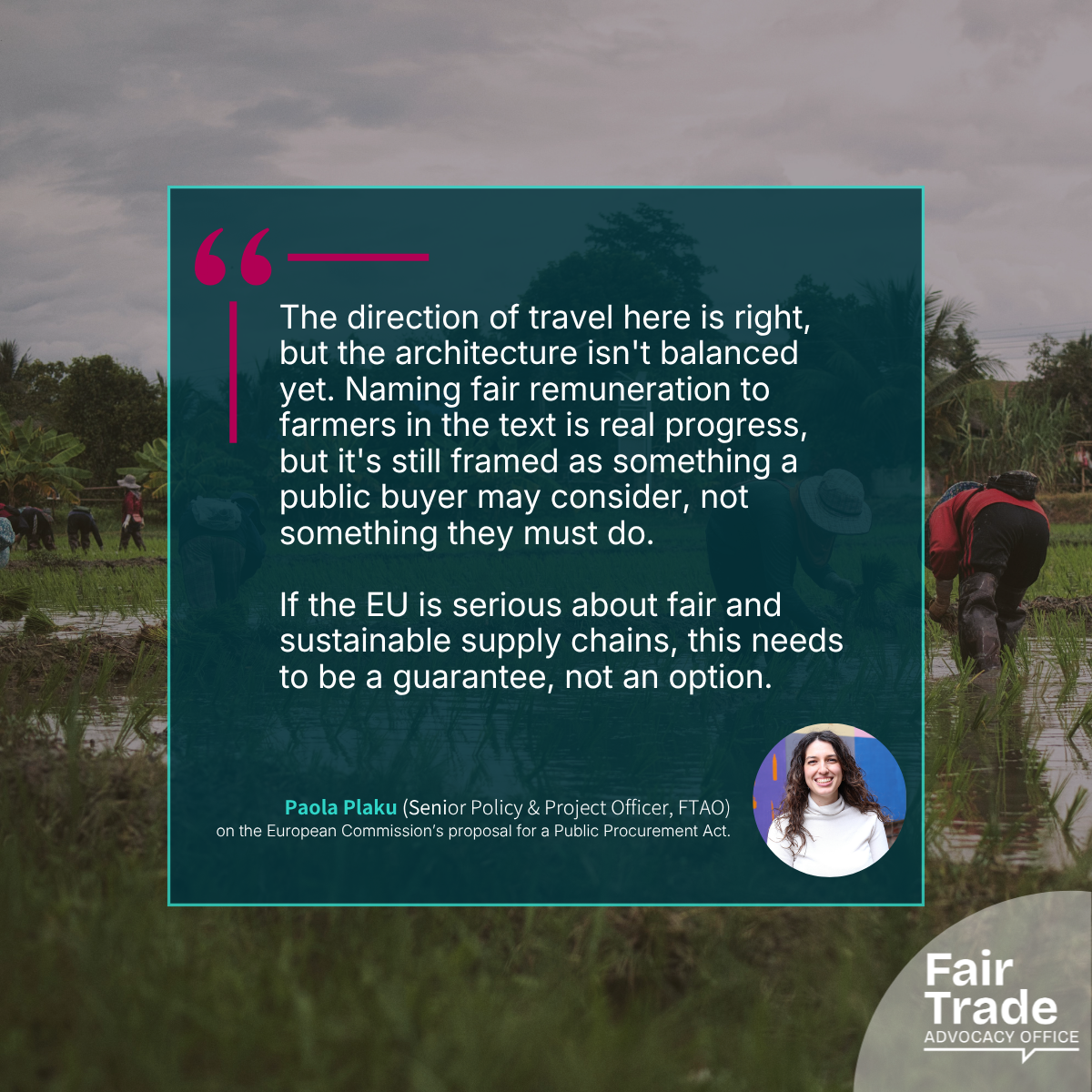
EU Public Procurement Act takes a step toward fairness, but legal guarantees are still missing