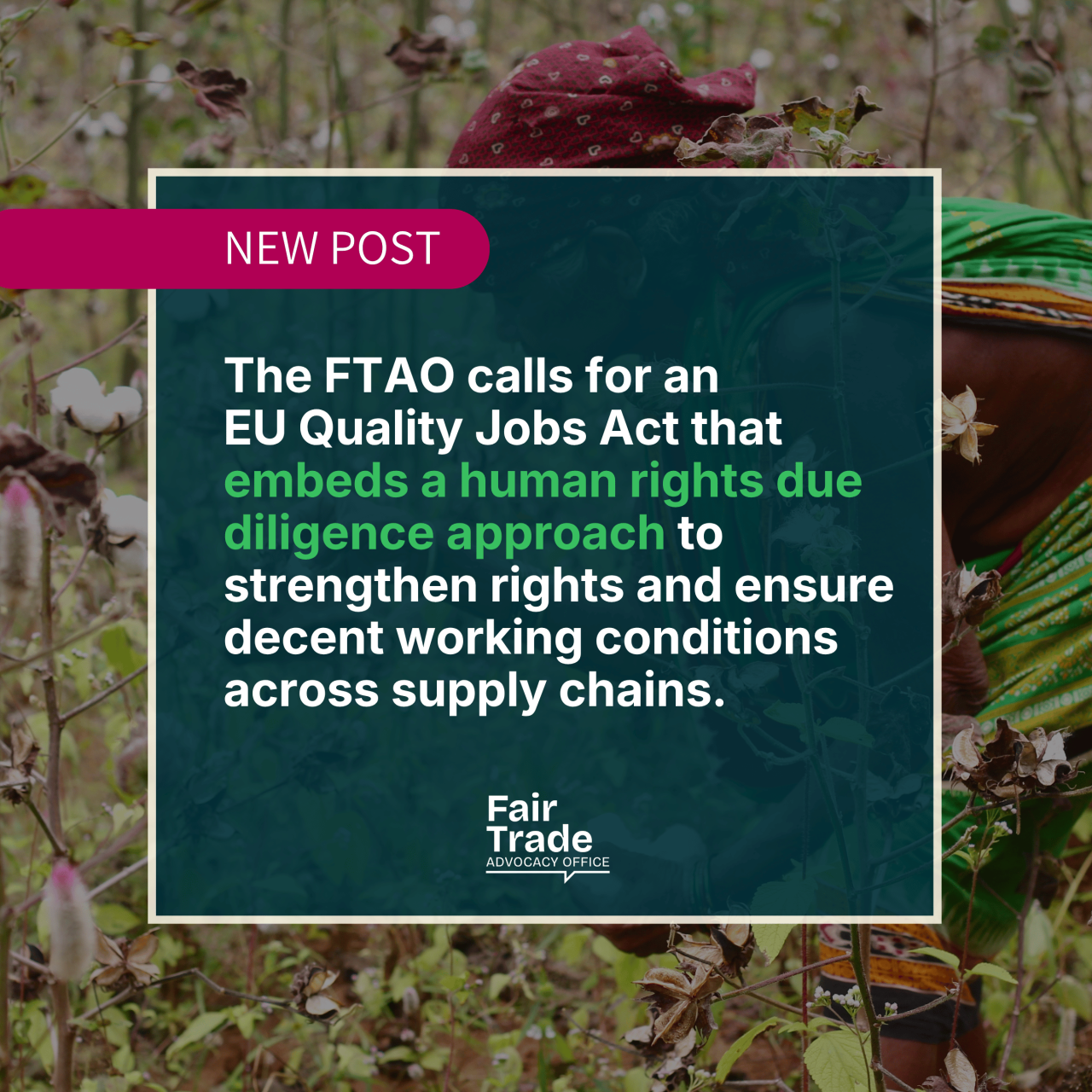
The Fair Trade Advocacy Office (FTAO) welcomes the European Commission's initiative to propose an EU Quality Jobs Act to support fair wages, good working conditions and workers’ rights.
Drawing on the garment and textile sector within the EU, the FTAO's contribution examines how supply-chain structures and unequal bargaining power can contribute to labour-rights abuses. These challenges are also present in agriculture, where a fragmented base of primary producers faces a concentrated buyer side, allowing commercial pressures to be passed down the supply chain and ultimately affect workers’ pay and conditions.
Further, our feedback highlights the importance of considering non-EU workers connected to EU companies through subsidiaries or subcontracting arrangements, helping prevent incentives to move lower-quality jobs outside EU jurisdiction and supporting a just transition in which workers do not bear the costs of change.
As the European Commission prepares its proposal for an EU Quality Jobs Act, the Fair Trade Advocacy Office sees an opportunity to strengthen workers’ rights and advance decent work across sectors and supply chains. Our recommendations focus on four key areas:
- Embedding HREDD as its organising principle, with proportionate EU-wide liability in subcontracting chains;
- Ensuring comprehensive protection for all workers, including subcontracted, migrant, seasonal and home-based workers;
- Addressing unfair purchasing practices, including purchasing below the cost of sustainable production;
- And advancing living wages for employees and living incomes for self-employed workers through enforcement, collective bargaining and freedom of association.
Read the FTAO's full set of recommendations here.
Get in touch
For more information, please reach out to our Senior Policy and Project Coordinator, Alena Kahle at kahle@fairtrade-advocacy.org.