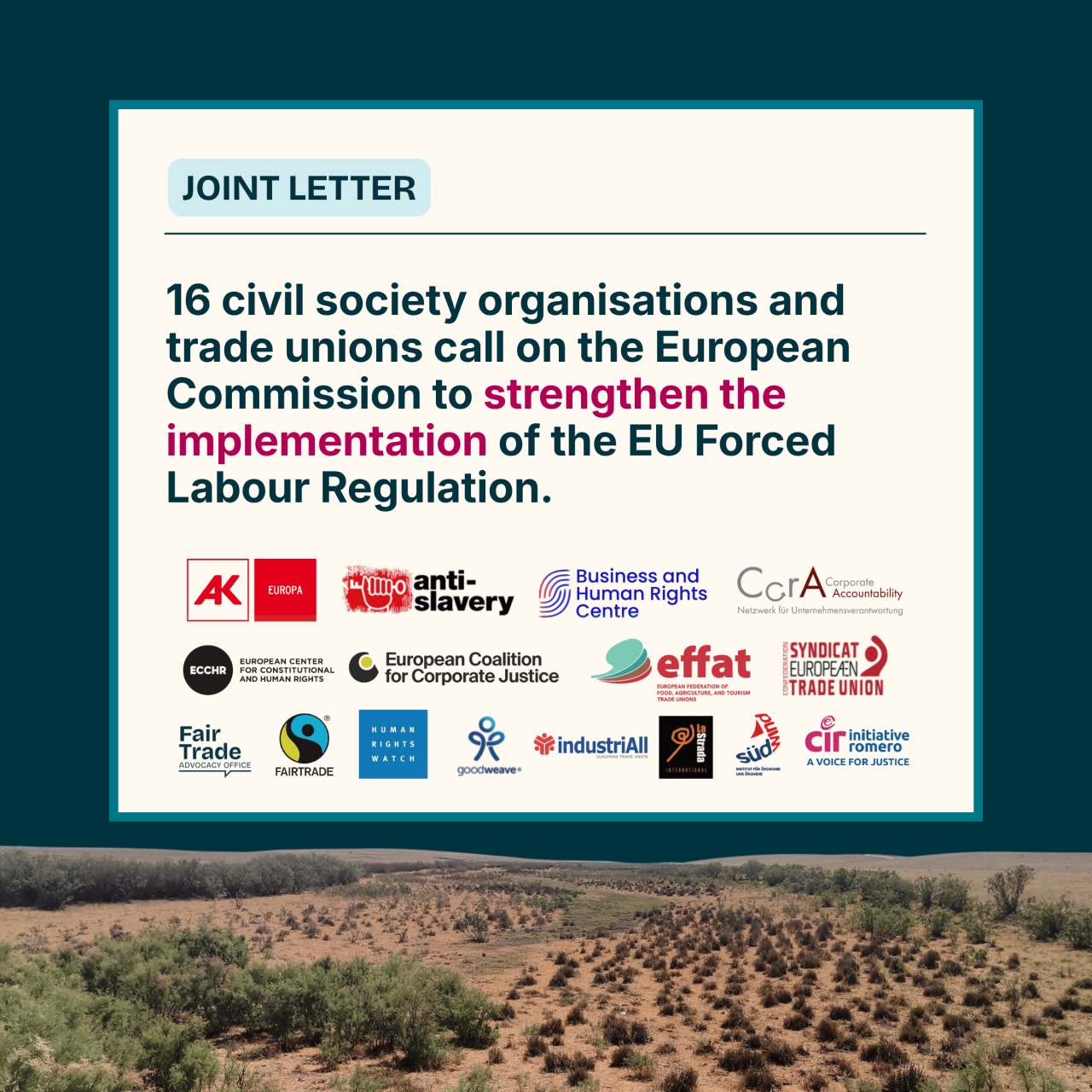
Joint letter: CSOs and trade unions call on the European Commission to strengthen the implementation of the EU Forced Labour Regulation
Dear Mr. Jakub BORATYNSKI, Director - Compliance and responsible business conduct (DG GROW),
Dear Ms. Dora CORREIA, Acting Deputy Director-General - Director - Trade relations with Africa, Caribbean and Pacific regions, South and South East Asia, Australia and New Zealand, Trade and Sustainable Development, the Green Deal (DG TRADE),
We, the undersigned organisations, welcome the publication on 26 June 2026 of the preparedness package including the Forced Labour Portal and the guidance, which sets out the implementation process and obligations for authorities and companies under Regulation (EU) 2024/3015 on prohibiting products made with forced labour on the Union market. We view this guidance as a key building block in the EU's broader forced labour architecture.
We particularly welcome several aspects of the guidance. It offers a clear definition of forced labour centred on involuntariness and coercion, along with a clarification of scope that covers extraction, harvesting, production, and manufacturing. It further recognises the need to protect workers and petitioners throughout the investigation process, including through confidentiality, and takes into account a broad range of evidence types.
The guidance also allows flexibility in submission requirements, reflecting the real challenges of gathering evidence of forced labour, and allows for a tailored evidentiary threshold that accounts for the complexity of documenting different types of forced labour cases. It further shows awareness of the particular constraints involved in documenting State-imposed forced labour, adapting the investigation and evidentiary threshold accordingly, and recognises that non-cooperation by economic operators is, in principle, relevant evidence in itself. Finally, on evidentiary standards, we welcome the exclusion of social audits conducted where workers are under threat, inducement or subject to surveillance by management.
This framework provides a solid foundation that could be further strengthened by addressing the following:
- The definition of forced labour and its indicators should be interpreted taking into account the social, economic and cultural context of the victim, reflecting the inherent case-specific nature of this exercise. Relatedly, we would caution against overreliance on the ILO forced labour indicators as a checklist to evaluate coercion and involuntariness. They should serve as a starting point for contextual analysis of how forced labour manifests and how it can genuinely be brought to an end, not as a substitute for it;
- In terms of the investigation procedure, future guidelines should:
- Clarify further the need to avoid overreliance on results of social audits submitted by economic operators during the investigative process to demonstrate absence of forced labour. Provide additional guidance to regulators to scrutinize audit quality, including but not limited to audits’scope, methodology, disclaimers and use of stock phrases by audit firms.
- Emphasise the importance of triangulating information submitted by economic operators during the investigative process through a tailored process that takes into account the risk of false compliance or worker coercion.
- Highlight that actions to identify, prevent and remediate forced labour must be appropriate and effective to be considered as relevant in mitigating and/or remediating forced labour.
- Ensure that Member States and the European Commission receive explicit capacity-building support and adequate financial and human resources for effective enforcement, including for the provision of adequate accompanying measures to economic operators, in particular SMEs (Art. 10).
We regret however, that the portal does not yet include a full list of Member States' competent authorities, even though EU Member States were required to designate one or more competent authorities by 14 December 2025.
Additionally, it does not include more detailed “guidance for economic operators on best practices for bringing to an end and remediating different types of forced labour” (Art. 11.b) nor on “due diligence in relation to forced labour imposed by state authorities” (Art. 11.f).
While we see that some elements on those two important issues have been included in the Guidance on due diligence in relation to forced labour, we believe they do not meaningfully address the depth or the range of possible measures needed for economic operators to respond adequately.
We believe the Commission's guidance, without being prescriptive, should provide enough detail to be actionable by economic operators. Further detailed recommendations will be provided in the coming weeks, and we would welcome the opportunity to meet with you to present them.
We look forward to continuing our constructive exchange on this important topic and remain at your disposal for any questions.
Kind regards,
Signatories:
- AK EUROPA
- Anti-Slavery International
- Business and Human Rights Centre
- European Federation of Food, Agricultural and Tourism Trade Unions (EFFAT)
- European Trade Union Confederation (ETUC)
- CorA Network for Corporate Accountability (Germany)
- European Coalition for Corporate Justice (ECCJ)
- ECCHR
- Fair Trade Advocacy Office
- Fairtrade International
- GoodWeave International
- Human Rights Watch
- IndustriAll Europe
- La Strada
- International Romero Initiative
- SÜDWIND e.V.
More From The Workstream
The Fair Trade Movement’s input to the Call for evidence for the Guidelines of the EU rules on forced labour

Framework of accompanying measures for the EU Forced Labour Regulation
From trade wars to trade justice: less, fairer, better