EU Public Procurement Act takes a step toward fairness, but legal guarantees are still missing
The Fair Trade Advocacy Office takes note of the European Commission's proposal for a Regulation on Public Procurement revising the 2014 legal framework and welcomes the move away from lowest-price criterion, a long-standing ask of the Fair Trade Movement.
For the first time, the proposal explicitly recognises Fair Trade as a valid consideration in public procurement when linked to the subject matter of the contract, providing contracting authorities with a legal basis to reward fair trade practices, which could open the door to more responsible public purchasing across the EU. Additionally, the proposal recognises labels as valid means of proof that help public buyers verify environmental, social or other required characteristics in public procurement. Building on this, the Fair Trade Movement emphasises that the Public Procurement Act should go further in recognising robust, existing labels as reliable proof of these practices.
In addition, the FTAO particularly welcomes the recognition of food procurement as a distinct priority area in its own right, as well as the role of consumers and the importance of bringing public settings such as schools and hospitals closer to sustainable food production. The FTAO also appreciates the acknowledgment of the role of organic products in contributing to the EU’s environmental and social objectives and applauds the inclusion of fair remuneration for farmers despite being linked to the subject-matter.
Furthermore, we commend that human rights protection across supply chains is now named explicitly as a social objective public buyers may pursue. However, this provision rests on a narrower basis, as it replaces Article 31 of the Corporate Sustainability Due Diligence Directive (CSDDD), which allowed compliance with due diligence obligations to count as an award criterion on either social or environmental grounds.
The proposal also strengthens incentives for prompt payment and to split large contracts into smaller lots, which could help smaller Fair Trade suppliers compete alongside SMEs rather than being excluded by large, bundled tenders; retains the social economy as named objective; encourages pre-market consultations, proposes the creation of procurement competences centres in Member States; and introduces mandatory monitoring of social and environmental outcomes through National Public Procurement Data Spaces.
These improvements, however, sit inside a Regulation whose overall architecture still treats fairness as a secondary concern. The restrictive "link to the subject-matter" requirement is carried over largely unchanged from the 2014 Directive, which could perpetuate the same restrictive interpretation and legal uncertainty public buyers have faced for over a decade. Furthermore, we regret that the Commission lets European preference crowd out sustainability options, rather than ensuring fair and sustainable supply chains have room to grow alongside them.
While the FTAO welcomes the Commission’s commitment to move away from over-reliance on lowest price criteria, its effectivity will depend on how public buyers use it in practice, as quality can currently be met without any social or environmental content at all. Social, environmental, European-preference and innovation considerations all draw on the same limited pool of quality points, so weight given to one comes at the expense of the others rather than each being guaranteed its own space.
In parallel, while a public food procurement provision is a step in the right direction, its entirely optional ("may") form treats fairness as just one consideration among five, sitting alongside organic production, nutritional value and animal welfare.
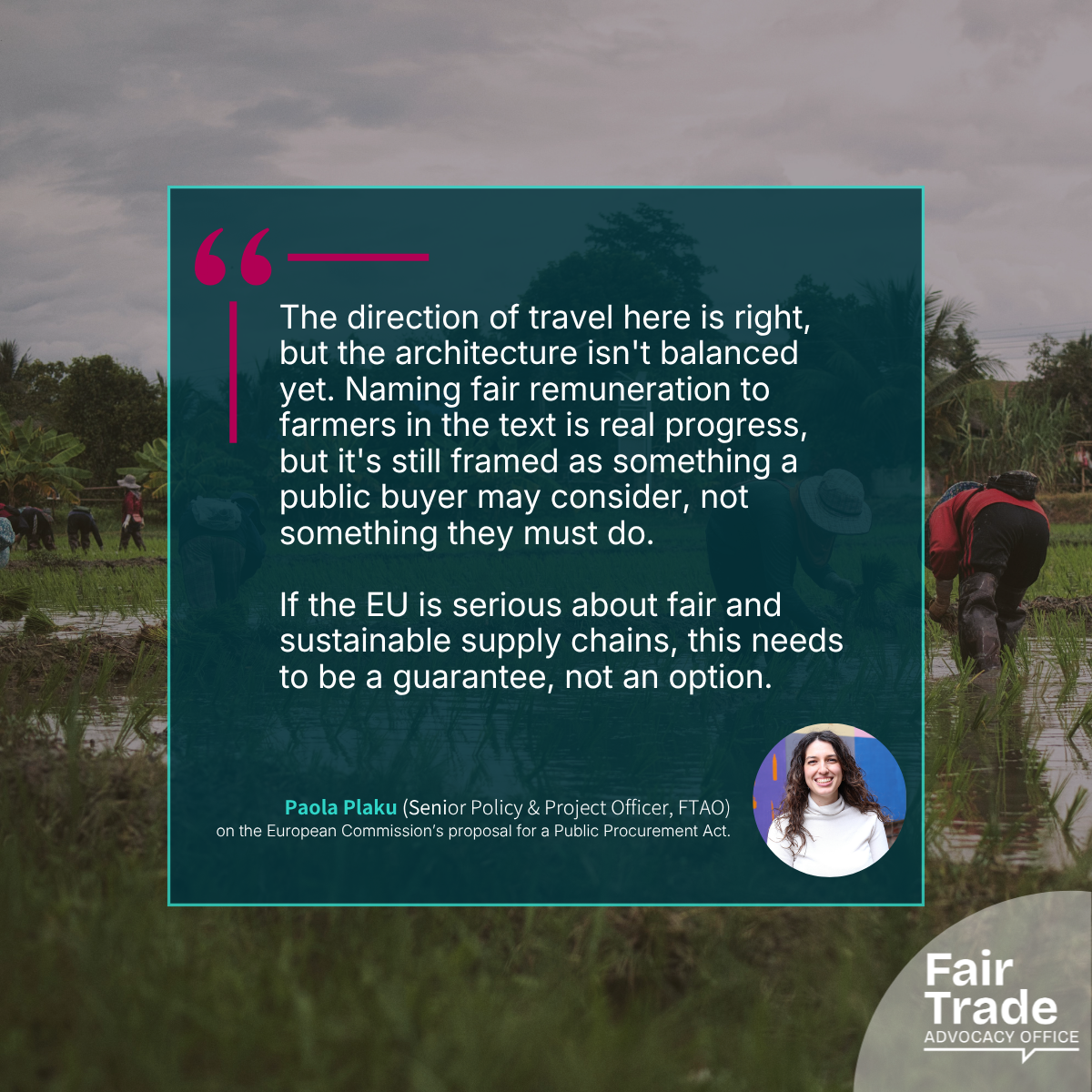
- "The direction of travel here is right, but the architecture isn't balanced yet. Naming fair remuneration to farmers in the text is real progress, but it's still framed as something a public buyer may consider, not something they must do. With public procurement shaping 15% of the EU's economy, we can't afford for fairness to depend on which official happens to read the fine print. If the EU is serious about fair and sustainable supply chains, this needs to be a guarantee, not an option." Said Paola Plaku, Senior Policy and Project Officer at the Fair Trade Advocacy Office (FTAO).
While commending the European Commission's efforts in delivering a balanced proposal, the Fair Trade Movement stresses that the current text needs further operative force before it can deliver on its full potential for fair, sustainable trade. As the co-legislators negotiate their positions, the FTAO urges the European Parliament and the Council to use the legislative process to strengthen the proposal further, so that fairness to workers and producers carries the same operative weight as simplification and competitiveness ambitions.
Get in touch:
For more information, please contact Paola Plaku, Senior Policy and Project Officer at the FTAO at plaku@fairtrade-advocacy.org.
More From The Workstreams
Organic Regulation deal gives certainty to Fair Trade producers
Strengthening Socially Responsible Public Procurement Through Due Diligence: Lessons from EU Member States

Fair Trade Towns bring local action to the heart of the EU debate on public procurement