NGOs, trade unions, social economy organisations and progressive businesses welcome progress in Public Procurement Act but call for stronger social and environmental safeguards
The coalition is glad to see that the proposal reflects some of our long-standing recommendations provided during the evaluation of the current EU public procurement framework. These demands cover nine priorities, including award criteria, the enforcement of social clauses and stronger supply-chain requirements.
However, several key proposals have been weakened, made discretionary or left out altogether. In particular, the ASDPP highlights the following concerns and calls on the European Parliament and the Council to strengthen the proposal during the legislative process.
(ASDPP), a coalition of social and environmental NGOs, trade unions, social economy organisations and progressive businesses, welcomes the European Commission's proposal for a Public Procurement Act (PPA).
The coalition is glad to see that the proposal reflects some of our long-standing recommendations provided during the evaluation of the current EU public procurement framework. These demands cover nine priorities, including award criteria, the enforcement of social clauses and stronger supply-chain requirements.
However, several key proposals have been weakened, made discretionary or left out altogether. In particular, the ASDPP highlights the following concerns and calls on the European Parliament and the Council to strengthen the proposal during the legislative process:
- Price-Quality Ratio (BPQR): The proposal makes the shift possible from an over-reliance on price to the Best Price-Quality Ratio (BPQR) under Article 98, with a minimum 30% (50% for labour-intensive contracts) weighting for quality criteria, an approach the coalition has long advocated. However, the proposal allows a broad range of considerations to compete for the same fixed share of the score, including functional characteristics, qualification of staff, environmental or social considerations, European preference, and innovation. As a result, giving greater weight to one consideration necessarily reduces the potential weight of others.
- Access for social economy organisations and reserved contracts: Reserved contracts for work-integration organisations and sheltered employment (Article 57(1)) and for non-profit social/welfare services (Article 57(2)) are maintained but remain discretionary ("public buyers may reserve [...]") rather than becoming mandatory tools as the coalition requested. Article 100 carries over the existing "comply or explain" logic on division into lots, buyers "shall consider" dividing contracts and must justify if they don't, but this is not new and does not amount to the mandatory market reservation or smaller-lot requirement for social economy actors.
- Labels: Article 91 of the proposal sets out five conditions for the use of labels but does not appear to materially strengthen the existing framework. In practice, this leaves contracting authorities and reviewers with the responsibility of assessing the credibility and robustness, creating unnecessary complexity and legal uncertainty for well-established and credible sustainability labels.
- Social and environmental sustainability criteria: Both social (Art. 55) and environmental (Art. 50) considerations remain optional under the proposed PPA, leaving uptake largely dependent on individual procurers' discretion. The Act takes one step further on the environmental side: for high-impact sectors, it requires public buyers to include environmental criteria (Art. 50, Annex VII), though it still leaves the substance of those criteria to procurers, partly by repealing existing EU sectoral legislation. This risks reducing consistency across single market geared toward decarbonisation. No comparable mandatory anchor exists on the social side. The coalition therefore urges co-legislators to strengthen the mandatory basis for both social and environmental criteria, so sustainability ambition does not rest solely on procurer discretion.
- Subcontracting: The Act prohibits subcontracting of the entirety of the public contract and contracting authorities can require contractors to perform certain critical tasks directly. These are positive changes recognising that excessive subcontracting has a negative impact on executing public works. However, it does not do enough to limit long and complex subcontracting chains and ensure that sustainability and labour standards are respected throughout the chain.
- Monitoring and data: The coalition welcomes the proposal’s provisions on procurement data. Mandatory National Public Procurement Data Spaces linked to a Union-level Data Space can support systematic collection of Sustainable Public Procurement data, provided they capture social and environmental performance. To fulfil this potential, however, these data spaces must capture not only spending and procedural information but also relevant social and environmental performance indicators. Reliable data will be essential for monitoring implementation, identifying gaps and improving policy.
The ASDPP coalition will work to further strengthen the current proposal during the legislative process and stands ready to provide further technical input to the co-legislators as the legislative process unfolds.
About the ASDPP:
The Alliance for Sustainable Development in Public Procurement (ASDPP) is a group of social and environmental NGOs and trade union organisations (individual, confederal and EU federal) united by their joint aim to achieve progress in sustainable development through enabling EU public procurement legislation and policies. For more information, please reach out to Pablo Sánchez Centellas at psanchez@epsu.org; or to Paola Plaku at plaku@fairtrade-advocacy.org.
More From The Workstream
Strengthening Socially Responsible Public Procurement Through Due Diligence: Lessons from EU Member States

Fair Trade Towns bring local action to the heart of the EU debate on public procurement
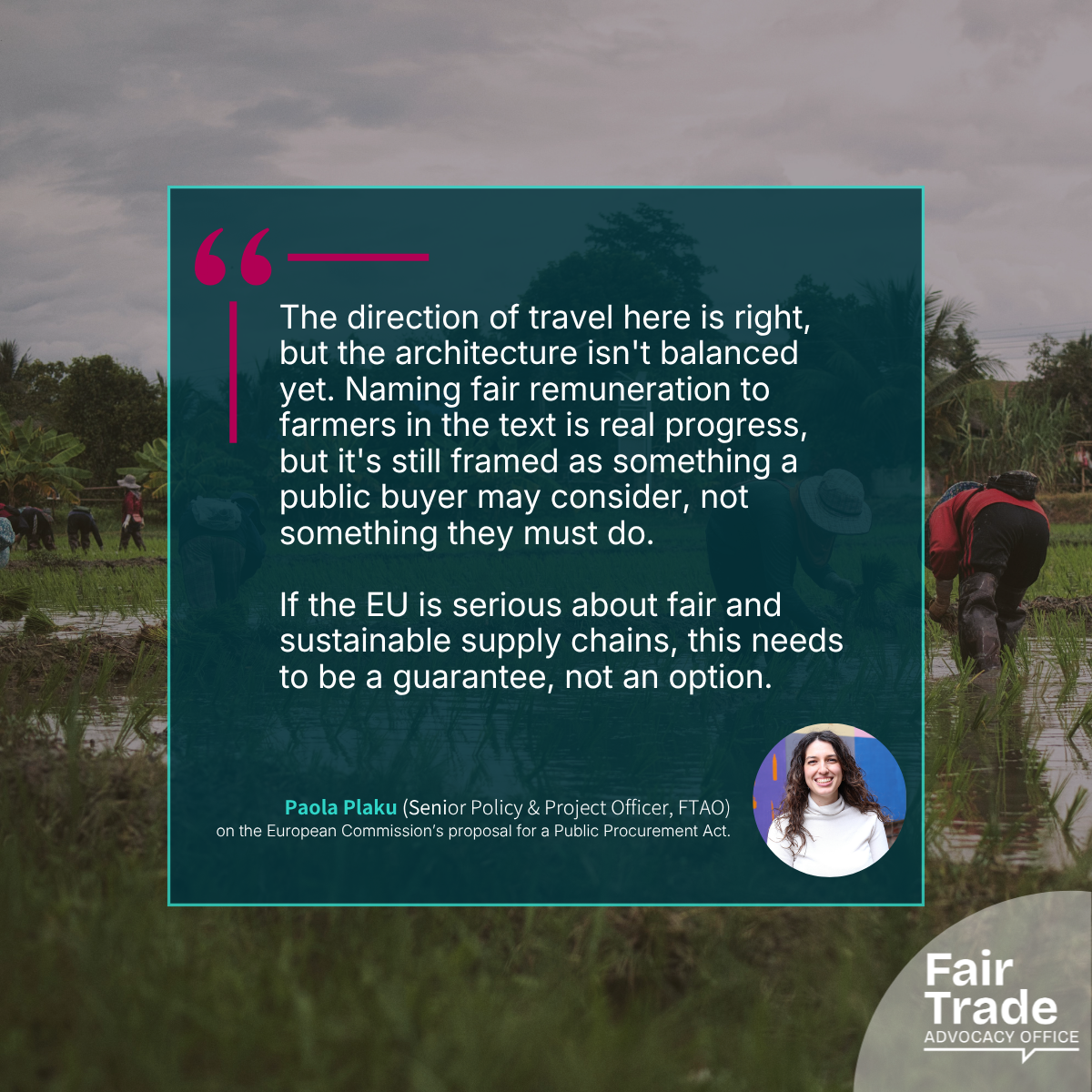
EU Public Procurement Act takes a step toward fairness, but legal guarantees are still missing