Why the Digital Product Passport is (also) a public procurement story
By Paola Plaku and Alena Kahle
Public buyers in the European Union spend roughly 14% of GDP every year on goods, services and works. Textile products make up a significant part of this spending, covering items such as uniforms, healthcare clothing, workwear and other professional garments. That makes public procurement one of the most powerful levers the EU has to steer demand toward more sustainable and transparent garment supply chains.
The European Commission has long recognised this potential in 2017, a Commission Staff Working Document set out voluntary green public procurement criteria for textiles, which is used by EU actors in current practice. Recent legislative developments, however, suggest that an overhaul of these criteria is long overdue.
On the one hand, the EU is revising its public procurement rules, with a proposal for an updated Public Procurement Act expected in September 2026. On the other hand, the European Commission is developing Ecodesign criteria for textiles, including dedicated green public procurement rules, which will be communicated via a Digital Product Passport (DPP).
Once the DPP is fully operational, public authorities are bound to have more information available about the sustainability of textiles they procure. Yet so far, policy discussions have given very limited attention to this opportunity. The Fair Trade Advocacy Office (FTAO) is convinced that the Ecodesign for Sustainable Products Regulation (ESPR) and its flagship tool, the Digital Product Passport, must be designed in synergy with procurement policy.
Meanwhile, the Commission proposal for a unified public procurement rulebook is framed around harmonisation, a single Regulation intended to replace the three existing procurement directives (2014/24/EU, 2014/25/EU, and the Concessions Directive 2014/23/EU), with particular attention to supporting smaller contracting authorities that lack dedicated sustainability expertise. A well designed DPP fits naturally into that goal: instead of each buyer independently assessing certifications or building up in-house expertise, standardised DPP data lets them check compliance once, at the product level.
Why textiles and public procurement
Textiles are not a marginal case for public buyers. According to the European Commission's Joint Research Centre, occupational clothing, special workwear and accessories made up 42-46% of all apparel publicly procured in the EU between 2015 and 2019, the largest single category, and the number of apparel contract awards rose steadily over that period, from 556 in 2015 to 1,261 in 2019. Uniforms, workwear, healthcare textiles and defence textiles are thus recurring, high-volume public purchases across every Member State, and public purchasing decisions in this sector have a direct impact on industrial resilience, sustainability and security of supply.
Yet, price still tends to dominate award decisions even where sustainability criteria are formally included in a tender, often favouring low-cost imports that do not meet EU environmental or social standards. That is not a hypothetical distortion. On one side, the EU textile and clothing sector, worth an estimated €166 billion in turnover and employing around 1.2 million people inside the EU alone, sources most of its raw cotton from roughly 250 million smallholder farmers worldwide, whose livelihoods and market access can be strengthened or undermined depending on whether EU rules recognise sustainable and fair sourcing practices. On the other, the production of textiles procured via EU tenders are associated with labour rights violations documented on the ground by groups such as AWAZ Pakistan, conditions that public money should not be indifferent to when it buys uniforms and workwear at scale.
This is precisely why the FTAO sees ESPR and the DPP as unfinished business unless they are read together with procurement law. A textile Ecodesign framework that sets ambitious sustainability criteria, but that public buyers cannot verify at the point of purchase, leaves one of the EU's most direct levers over the garment sector sitting idle.
The legal hook
Under the Ecodesign for Sustainable Products Regulation (ESPR), Article 65 requires public buyers to award contracts complying with minimum sustainability requirements for products covered by ESPR delegated acts. Crucially, Article 65(2) requires requirements to take into account economic feasibility for public buyers. The Commission will be setting minimum requirements for all textile apparel allowed on the EU market via a delegated act and will in tandem develop green public procurement criteria for textiles under Article 65(3). Specifically, the ESPR itself backs the argument that sustainability and cost are compatible when procurement is designed well. In addition, public authorities are bound to derive benefits from the development of Digital Product Passports, which will be required for all textile apparel products on the EU market and will communicate key sustainability information. Contracting authorities will rely on it to apply and verify the green public procurement criteria. Article 11(b) of the ESPR in fact lists a broad range of actors as being entitled to free and easy access to DPP data, recognising that the DPP will be a key tool for countless purposes.
Why certification-based criteria already work and why the DPP needs to carry them
The textile delegated act cannot be designed in isolation from the green procurement rules that will be derived from it. Green public procurement criteria can only reference product aspects the delegated act covers, so the act has to be built in alignment with the GPP criteria to come and rooted in what public authorities actually need to buy sustainably.
Under Article 43 of Directive 2014/24/EU, contracting authorities may already require sustainability labels as proof that products meet specified characteristics, provided these are linked to the subject matter of the contract, and public authorities across the EU already use this route in textile tenders. The City of Bonn, for example, accepted the Fairtrade Textile Standard, Fair Wear Foundation, and SA8000 certifications, among others, as proof of compliance in its workwear procurement. However, this practice remains fragmented across Member States, resting on individual buyers' initiative rather than a shared, verifiable data source.
A well designed DPP could fix exactly that: standardised, verifiable certification data attached to every garment, so buyers can build certification-based Best Price Quality ratio criteria without reinventing the wheel or chasing paperwork supplier-by-supplier, in every tender.
The efficacy of this approach depends on the information requirements mandated for textile DPPs under the ESPR. Here, the FTAO has flagged a serious gap. Current design options for the ESPR textile delegated act might not even consider sustainability labels, nor the sourcing of raw materials at all.
In its April 2026 feedback to the Joint Research Centre's preparatory study on textile products, the FTAO warned that the current design options rely mainly on voluntary disclosure and omit raw material sourcing entirely, despite the JRC's own lifecycle analysis showing that raw material production (cultivation, extraction, processing) accounts for 60–63% of a garment's total lifecycle environmental impact. We raised that the product aspect “sustainable raw materials” listed in the Annex as an aspect that the ESPR textiles delegated act could set criteria on, is going unused, and proposed how the aspect of sustainable sourcing could be operationalised via Sustainably Sourced Renewable Materials (SSRM), so that established and credible certification systems under the ESPR framework and can flow through into the DPP.
Since green public procurement criteria can generally only reference product aspects already covered by the ESPR, leaving raw material sourcing out of the delegated act would mean procurement rules are structurally unable to reward sustainably sourced materials, however good a buyer's intentions. The delegated act is expected by late 2027; this is the window in which that gap can still be closed.
The infrastructure question: can public authorities meaningfully use the DPP?
Setting the right ecodesign and green public procurement criteria only works if public buyers can reach the data behind them. Contracting authorities need legitimate access to the specific information laid out in a tender, and the creation of mandatory DPPs can close this practical gap. On delivery, receiving staff can scan a garment's DPP to confirm it matches the tender criteria, bridging the gap between the teams who write requirements and those who receive the goods. The already instated DPP for construction products, which is implemented as of January 2026, already demonstrates this use case in practice.
To this end, public procurement must be recognised as a use of the DPP in its own right, not treated as an afterthought behind customs and market-surveillance checks as current discourse does. The DPP Registry, the infrastructural backbone through which the DPP will be hosted, went live on 20 July, and will matter greatly to procurement practitioners. In our submission to the Commission's consultation on the draft Implementing Regulation, the FTAO argued that public authorities should be recognised among the actors entitled to access, deriving from the ESPR’s legal basis (Article 11(b)).
Public authorities remain omitted in the final legal text underlying the DPP Registry. It is not the end of the road: the registry only sets who can get into the system, while the product-specific delegated acts due in 2027 decide what data is actually there (i.e. certification status, raw material sourcing, facility-level information) and who may see it (public authorities, civil society...). But the omission shows how easily public procurement drops out of view when this infrastructure is designed.
A parallel reform raises the stakes
The recently leaked draft of the European Commission’s proposal for a Public Procurement Act, signals a shift toward giving quality and strategic criteria, including environmental, social and resilience considerations, greater weight over price, alongside new "Made in Europe" and origin-related criteria for tenders.
For years, the FTAO has been calling for a horizontal procurement reform that formally elevates sustainability and human rights due diligence criteria. But this will only deliver for garment workers and producers if it rests on DPP data that is complete, accessible to procurement authorities and trustworthy on certification.
Put simply, the Public Procurement Act reform, green public procurement criteria for textiles under the ESPR, accompanied by the development of DPPs, are three pieces of the same puzzle. The first sets the legal obligation to buy more sustainably, the second sets the specific criteria for textiles, and the third provides the specific evidence that makes that obligation verifiable in practice. All three pieces are moving forward in parallel over the next few months, and none of them will work properly without the other.
Where this leaves the FTAO
Public procurement sits at the heart of the FTAO’s work on fair and sustainable supply chains. Through our continuous work with Fair Trade Towns, public buyers and advocacy coalitions, and through our ongoing dialogue with the European Commission, we try to help ensure that the link between ecodesign, public procurement and labour rights is not overlooked.
As a member of the Commission's Ecodesign Forum, the main expert group consulted on ESPR's implementation, we have a continue to contribute to discussions as these rules take shape. Furthermore, we continue to raise these links in a range of Commission consultations and expert group discussions covering public procurement and the development of the Digital Product Passport. This includes facilitating dialogue between stakeholders from producer countries and EU policymakers. In July 2025, for instance, we facilitated exchanges between Pakistani labour rights expert Zia ur Rehman (AWAZ Pakistan) and Members of the European Parliament, as well as with the European Commission’s Directorate-General for Internal Market, Industry, Entrepreneurship and SMEs (DG GROW), to discuss the links between EU public procurement and labour rights violations in the garment sector.
Looking ahead, the FTAO will continue to bring the perspectives of smallholder farmers, workers, and artisans to the fore as the Commission develops the textile delegated act expected in 2027, bring recommendations to the Ecodesign Forum, and step up engagement with public buyers. We will also follow and actively engage in the legislative process as the Public Procurement Act moves from the leaked draft emerged in July to the formal proposal scheduled for September 9, to make sure the sustainability ambitions on paper are matched by data infrastructure that buyers, and the workers and producers behind the products they buy, can actually rely on.
Get in touch:
For more information, please reach out to Paola Plaku plaku@fairtrade-advocacy.org or Alena Kahle at kahle@fairtrade-advocacy.org.
More From The Workstreams

Fair Trade Towns bring local action to the heart of the EU debate on public procurement
NGOs, trade unions, social economy organisations and progressive businesses welcome progress in Public Procurement Act but call for stronger social and environmental safeguards
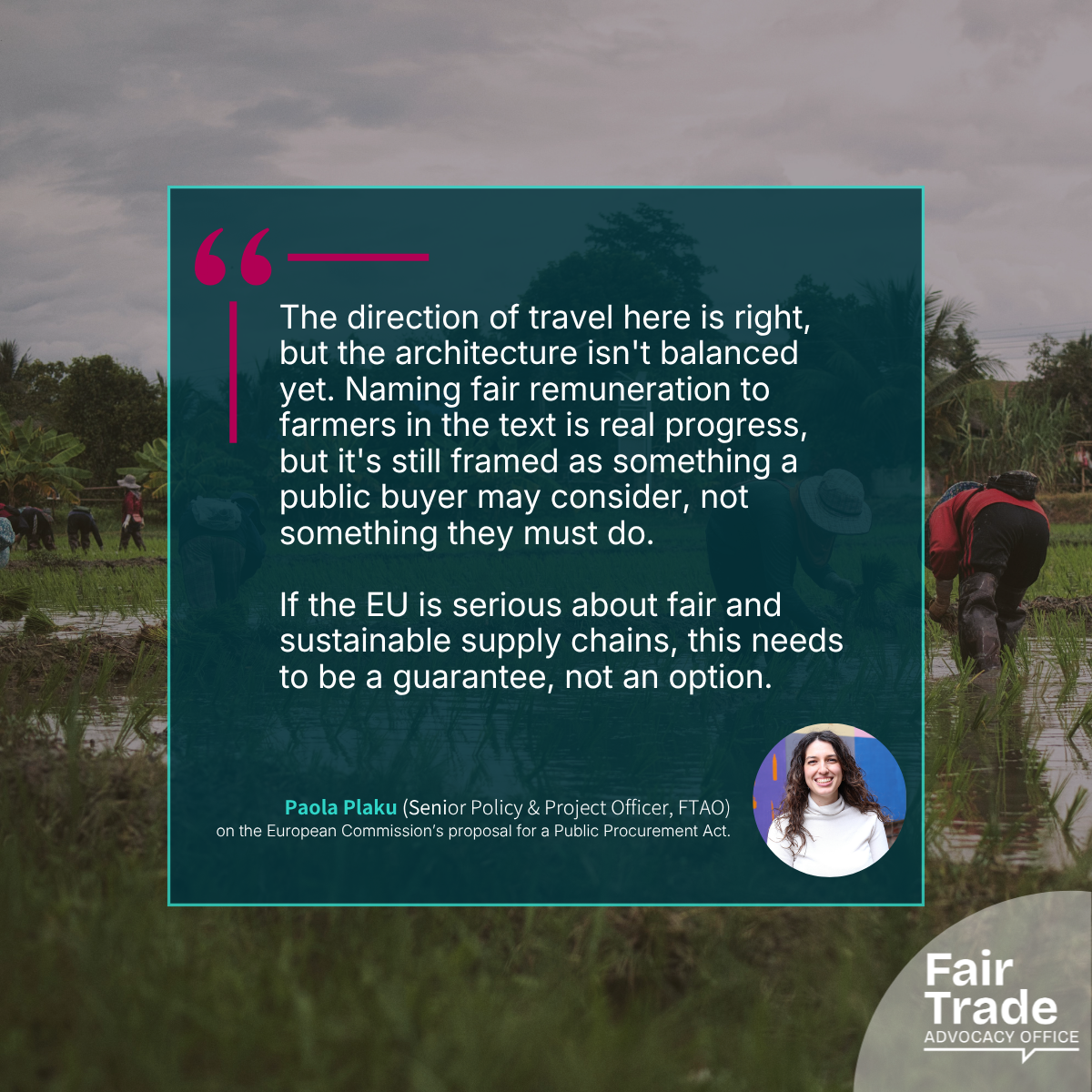
EU Public Procurement Act takes a step toward fairness, but legal guarantees are still missing