Shaping EU ecodesign rules for the garment sector: our feedback on the JRC's Preparatory Study on Textile Products
The Ecodesign for Sustainable Products Regulation (ESPR) is a landmark EU law designed to remove the least sustainable products from the market by setting binding requirements on how products are designed, produced, and perform. By early 2027, the European Commission is expected to adopt a delegated act on textile apparel that will set minimum performance criteria and information requirements. As part of this process, the Joint Research Centre (JRC) recently consulted stakeholders on its preparatory study. The Fair Trade Advocacy Office (FTAO) submitted detailed feedback on the main design options, with particular attention to the implications for smallholder cotton farmers, artisans, and the Fair Trade Movement.
Overall, we believe the JRC working document is not ambitious enough to deliver the market transformation the ESPR is meant to achieve. The regulation is intended to make sustainable products the norm by excluding the worst performers. Yet the current design options rely mainly on information requirements and voluntary disclosure. These tools have limited and uncertain effects, mostly reaching engaged consumers and frontrunner brands, and are ill-suited to a sector still dominated by fast fashion business models.
This article summarises our main positions as submitted to the JRC.
Recycled content: textile waste must come first
The JRC proposes mandatory minimum recycled content requirements for textile apparel, for example requiring part of a garment’s polyester, nylon, or wool to come from recycled sources. This is welcome in principle. However, the proposal does not specify that recycled content must come from textile waste streams, and that distinction is critical.
We therefore propose that recycled fibres should come from post-industrial, pre-consumer, and post-consumer textile waste. If non-textile feedstocks such as plastic bottles are allowed to count, brands could meet recycled content targets without helping solve the textile waste crisis. It would also divert feedstock away from the packaging sector’s bottle-to-bottle recycling loops. Our exchanges with recyclers and social enterprises confirm that large volumes of textile waste are already collected but lack stable downstream buyers. A recycled content requirement that does not prioritise textile waste will not solve this structural problem.
At the same time, recycled content requirements alone cannot significantly improve the environmental profile of raw materials. Virgin fibre production will remain necessary for the foreseeable future, so any framework that ignores how virgin fibres are sourced leaves most environmental impacts untouched.
Raw materials: the missing design option
The biggest gap in the current JRC proposals is the absence of requirements on how raw materials are sourced and produced. Yet the JRC’s own lifecycle analysis identifies raw material production, including fibre cultivation, extraction, and processing, as the main environmental hotspot, accounting for 60–63% of total lifecycle impacts in textile apparel. Despite this, the current package contains no design option addressing this stage.
A key issue in the JRC's framing is an apparent conflation of “sustainable fibres” with “sustainably sourced” ones: The first suggests that sustainability is an inherent property of a fibre type, which is difficult to define objectively and risks oversimplification. The second focuses on how materials are produced and supplied, using objective and verifiable criteria linked to sourcing and production practices. This distinction is essential: in textiles, sustainability depends far more on cultivation, extraction, and sourcing practices than on fibre type alone. A recent open letter signed by 15 Members of the European Parliament echoes this concern, calling on the Commission to ensure that raw material sourcing is addressed within the ESPR textiles delegated act.
We therefore propose including Sustainably Sourced Renewable Materials (SSRM) as a distinct product aspect under the delegated act, initially as a mandatory information requirement and with a clear path toward future performance requirements. This is fully consistent with Annex I of the ESPR, which already lists the use of sustainable renewable materials among the environmental sustainability characteristics that ecodesign requirements may address. While the JRC recognises the EU Organic Regulation in the preparatory study, recognition of sustainable cultivation must go further, and established certification systems must be recognised. SSRM would focus on verifiable sourcing and production practices rather than broad fibre categories, making it well suited to an ecodesign framework.
Environmental footprint: a two-track approach grounded in LCA+
The JRC has proposed a voluntary information requirement on environmental or carbon footprint, limited to the manufacturing stage. Yet manufacturing represents only about 20% of total lifecycle impacts when using environmental footprint as the indicator, and just 6% when looking at carbon footprint alone. Participating brands could display a score showing how their product performs against a benchmark. We see two major flaws with this approach:
First, an indicator that excludes raw material production cannot meaningfully reflect a product’s overall environmental performance. Consumers could easily interpret a good score as proof of overall sustainability, even though the largest share of impacts remains outside the assessment. Second, a voluntary requirement would mainly be used by frontrunners, leaving much of the market unchanged and undermining the ESPR’s core aim of making sustainable products the norm.
We therefore propose a two-track approach: a mandatory performance requirement at the manufacturing stage, where processes are industrial, measurable, and suitable for enforceable benchmarks; and a mandatory information requirement at the raw material stage, covering key environmental impacts at farm or fibre-gate level. Both should be based on an LCA+ methodology that goes beyond the EU’s current Product Environmental Footprint (PEF) framework, which does not adequately capture biodiversity, soil health, pesticide use, or animal welfare. Relying on standard PEF risks systematically disadvantaging natural and organic fibres compared with synthetic alternatives, contrary to EU goals on biodiversity and sustainable agriculture.
Public procurement as a lever for change
The ESPR textile criteria will also underpin Green Public Procurement (GPP) criteria. This makes it even more important to include raw material sourcing in the delegated act. If procurement rules can only refer to product aspects covered by the ESPR, they would otherwise be unable to reward sustainably sourced materials. Existing practice already shows this is feasible. Under Article 43 of Directive 2014/24/EU, contracting authorities may require sustainability labels as proof that products meet specified characteristics, provided these are linked to the subject matter of the contract. Public authorities across Member States already use third-party sustainability certifications in textile tenders.
The City of Bonn, for example, accepted the Fairtrade Textile Standard, Fair Wear Foundation, SA8000, and other certifications as proof of compliance in workwear procurement. Including SSRM under the ESPR would help harmonise these fragmented national approaches and ensure that product regulation, procurement policy, and consumer protection law reinforce one another.
Ensuring the ESPR works for smallholder farmers and artisans
Throughout our submission, we highlighted the implications of the ESPR for smallholder cotton farmers, artisans, and mission-driven producers at the heart of the Fair Trade movement. Around 250 million smallholder farmers depend on cotton for their livelihoods, producing roughly 75% of the world’s cotton. Craft producers and cooperatives, operating through demand-driven, locally sourced, and labour-intensive models, are often structurally lower-impact than high-volume industrial production. Yet they are rarely reflected in the industrial datasets that shape EU regulation.
To preserve market access for these producers, performance criteria must reflect their capacities and production realities. Article 21 of the ESPR already foresees support for SMEs and micro-enterprises, including guidance, tools, and compliance support.
These provisions must now be made real through free and accessible calculation tools and harmonised secondary datasets that reflect diverse production models, including small-scale and artisan production. Without such measures, mandatory requirements could strengthen the position of the largest operators while disadvantaging those already leading on sustainability.
We will continue to engage in this process as the delegated act develops toward its 2027 deadline.
For further reading on our position on the Ecodesign for Sustainable Products Regulation, see our position paper.
Get in touch:
For any questions or to read FTAO's full feedback, please contact Alena Kahle at kahle@fairtrade-advocacy.org.
More From The Workstream
Why the Digital Product Passport is (also) a public procurement story
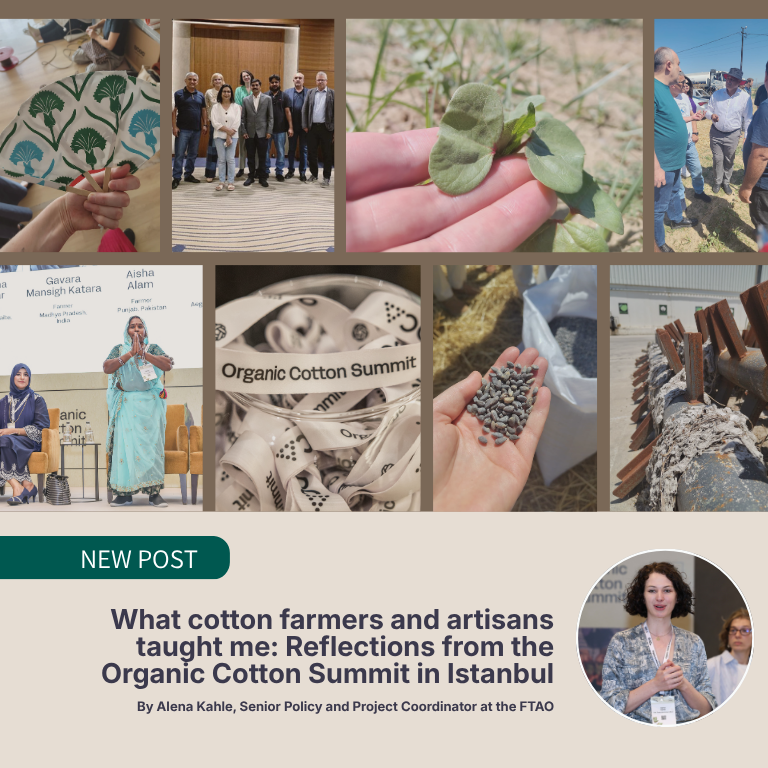
What cotton farmers and artisans taught me: Reflections from the Organic Cotton Summit in Istanbul
The FTAO's feedback on the European Commission’s draft Implementing Regulation establishing the Digital Product Passport (DPP) registry