EU Organic Regulation: Fair Trade Movement warns of risks posed by compromise amendments to Article 36 on Groups of Operators
The Fair Trade movement remains strongly supportive of the Commission's overall approach and its proposed changes to Article 36, which represent a meaningful step towards reducing certification burdens for smallholder producers in the EU and globally. We therefore urge the Parliament to preserve the spirit of the Commission proposal and restrict any changes to genuine, targeted improvements. In that spirit, we wish to raise three specific concerns.
1. Article 36(1)(b) – Eligibility criteria for group members: keep it simple and update-able
The Fair Trade movement welcomes the re-introduction of the 2% rule as an alternative eligibility criterion alongside the 10-hectare farm size limit (CA 2). This responds to our original request and avoids excluding small farmers who may slightly exceed the hectare thresholds.
However, we would like to flag that the 2% rule – while better than deleting the threshold altogether – remains a complex criterion in practice. The baseline for individual certification costs varies greatly between Control Bodies, the 2% calculation is difficult for producers and their organisations to apply reliably, and it is frankly a rule that very few actors in the field fully understand. We have witnessed real-world consequences: a number of cocoa producer organisations in 2025 moved to individually certifying larger members rather than navigating this uncertainty, resulting in certification cost increases that were, in several documented cases, 8 to 15 times higher than the year before.
By contrast, the current Council's approach – a straightforward €50,000 average annual turnover threshold (calculated over 5 years, with a delegation to the Commission to update limits via secondary acts) – is simpler, more predictable and arguably more producer-friendly. Producers, their organisations and Control Bodies can apply it without ambiguity. The delegation to update the figure is equally important, as it protects the threshold against erosion by inflation over time.
We are not asking the Parliament to contradict the approach taken in current compromise amendment, and we recognise that the 2% rule as an alternative to the 10-hectare limit may be more achievable in the current legislative context. But we would encourage MEPs to consider whether it would be possible to signal support for a clean '10 hectares OR €50,000 turnover' formulation (with an update mechanism), which we believe would be the most practical and most producer-friendly solution, particularly for smallholders growing high-value crops such as bananas or honey where even modest volumes can push turnover above a fixed threshold on occasion.
In short: the 2% rule is an acceptable fallback, but a plain fixed turnover threshold that can be adjusted over time is a better solution for producers and for legal clarity alike.
2. Article 36(1)(d) – Legal personality: the addition of 'including individual farm holdings' is confusing
Current text in CA 2 proposes replacing the present text of Article 36(1)(d) with the following:
'(d) have legal personality, including individual farm holdings, or be part of a farmer cooperative association, operator cooperative, association, federation or organisation that has legal personality;'
The addition of 'including individual farm holdings' is, in our view, difficult to understand and potentially counterproductive. A group of operators by definition consists of multiple members; allowing individual farm holdings to themselves constitute a 'group of operators' with legal personality risks undermining the concept entirely, or at minimum creates significant legal uncertainty.
The Fair Trade movement’s suggestion remains:
'(d) have legal personality or be part of a subgroup of a farmer cooperative, operator cooperative, farmer association, farmer federation or other type of farmer organisation that has legal personality;'
This formulation provides legal certainty for large cooperatives wishing to establish multiple Groups of Operators under a single legal entity – a practical necessity for organisations with thousands of members – while avoiding the confusion introduced by the current CA language.
3. Concerns over timeline
Beyond the substance, we would also urge the Parliament to consider the pace of this process. As things stand, a plenary vote is not expected before September 2026, which would push conversations with the Commission and Council into the fourth quarter of the year. This leaves very little time to finalise and adopt the changes before the end of the year — and Control Bodies, producer organisations and cooperatives across the EU and in third countries are actively waiting on the outcome. Many are already having to make practical decisions about their 2026 and 2027 control plans and certification structures without knowing what the final rules will look like. A swifter timeline would not only provide legal certainty sooner but would also reduce the operational disruption that uncertainty is already causing on the ground. We therefore encourage the Committee on Agriculture and Rural Development (AGRI) and the Parliament's leadership to explore all options to accelerate the process where possible.
In summary, the Commission’s proposal on Article 36 strikes a careful and broadly positive balance. The Fair Trade movement urges the European Parliament to protect that balance: support the Commission's text, consider the current Council's simpler turnover approach as a positive model worth emulating and reconsider the legal personality addition in CA 2 point (d). Producers in the EU and globally are counting on a workable, legally certain and inclusive Article 36.
Get in touch
For more information, please reach out to our International and Institutional Relations Manager, Virginia Enssle at enssle@fairtrade-advocacy.org.

More From The Workstream
Organic Regulation deal gives certainty to Fair Trade producers
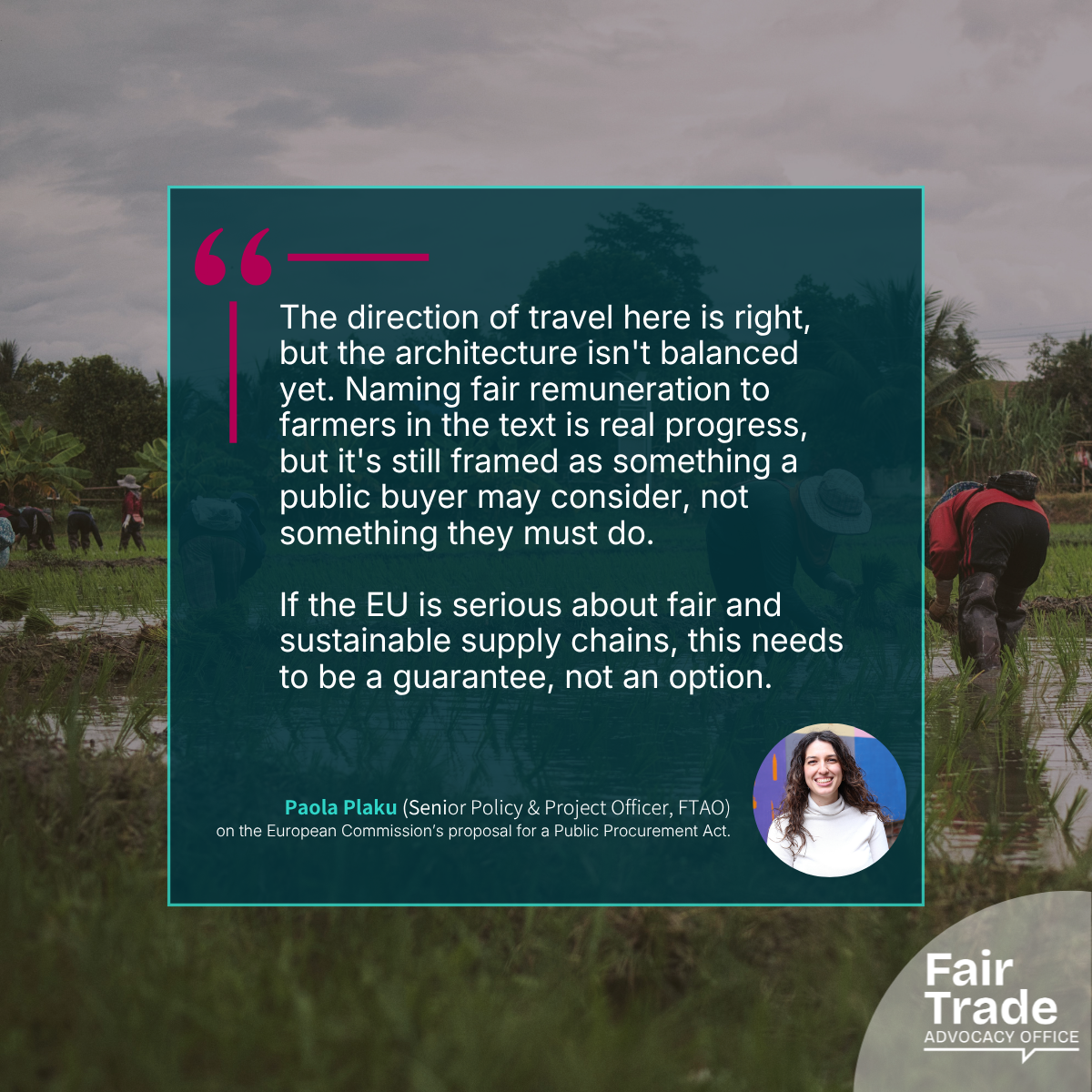
EU Public Procurement Act takes a step toward fairness, but legal guarantees are still missing
The revision of the EU’s rulebook for Public Procurement, a chance to deliver fairness