What Latin American coffee and cocoa farmers are telling us about one-size-fits-all EU regulations
By Virginia Enssle, International and Institutional Relations Manager at the FTAO.
The European Union has long been a champion of sustainable trade. The EU Deforestation Regulation (EUDR) and the updated Organic Regulation are among the most ambitious attempts yet to green global supply chains. As Fair Trade movement, we support their objectives. Forests must be protected and organic agriculture must uphold the highest standards to be credible. These are goals Fair Trade producers across Latin America have been working towards long before Brussels made them law.
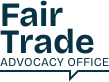
But good intentions do not automatically translate into good outcomes. A new study published by the Latin American and Caribbean Network of Fair Trade Small Producers and Workers (CLAC), covering Fairtrade coffee and cacao producers in Guatemala, Peru, Ecuador and Brazil, paints a sobering picture of what happens when significant regulatory change lands on the shoulders of those least equipped to bear it, and least consulted in its design.
Compliance costs are being shifted uphill
The EUDR is an EU regulation and its legal obligations fall squarely on EU operators, including importers, traders and companies placing products on the European market. Farmers and their cooperatives in Latin America are not within the legal scope of the regulation. In practice, however, much of the cost, data collection, documentation and administrative effort required for compliance, including the risk mitigation measures formally owed by EU operators, has been transferred up the supply chain to producers themselves.
Cooperatives have mobilised field teams to GPS-mapping hundreds of smallholder plots in remote areas. They have invested in geospatial platforms, hired legal and technical specialists they never previously needed, and redirected Fairtrade Premium funds, money intended for community development, into compliance infrastructure. One Peruvian cacao cooperative estimated spending between $60,000 and $100,000 USD on EUDR adaptation alone. Peruvian coffee organisations report that new compliance systems have doubled their administrative costs. The Union of Ecuadorian Cocoa Farmers' Organizations (UNOCACE) in Ecuador calculated initial compliance costs of around $5,000 USD per member organisation, representing tens of thousands of dollars across its network.
And what have buyers contributed? The study's findings show that most buyers have not offered meaningful co-financing. Some have provided technical advice or supported isolated components, but systematic cost-sharing is the exception, not the rule.
This is not how a fair trading relationship should work. If compliance with EU law is necessary to access the EU market, and if the costs of that compliance are real and substantial, then the actors with the most financial power in the chain, including European importers and brands, must share the burden. Expecting small-scale farmers in the Global South to subsidise the EU's regulatory agenda is neither fair nor coherent.
The organic regulation is dismantling cooperatives
If EUDR's implementation challenges are significant, the impact of the updated Organic Regulation deserves even sharper attention. Criteria such as the 2,000 members cap per organic operator group, alongside the requirement that all members produce exclusively organically, and the limits on farm size (5 hectares of organic land) and annual organic sales (€25,000) per member, may reflect the reality of small organic operations in Europe, but they fail to capture the reality of cooperatives in Latin America (and Africa and Asia).
The consequences are severe as cooperatives that have spent decades building inclusive, mixed-membership organisations are now being forced to split, separating organic from conventional producers, creating parallel legal entities, and in many cases formally excluding members who cannot or will not convert to organic production. This strikes at the cooperative model itself.
What is at stake here goes beyond certification. The cooperative movement was built on principles of inclusion, solidarity and collective empowerment. When a regulation designed and decided in Brussels forces a Guatemalan or Peruvian cooperative to tell some of its members "you are no longer part of our certified group", it is not just a bureaucratic inconvenience but a hit on the social fabric that the Fair Trade and cooperative movements have spent decades building.
More requirements, no market reward
Despite rising requirements to access the EU market, producers who meet them have not seen a corresponding increase in market reward. Just being able to continue exporting to the EU market is not contributing to improve the livelihoods of farmers outside of the EU, as costs continue to rise for them, yet price they receive do not rise accordingly.
CLAC documents that the price differential between certified organic and conventional coffee and cacao has narrowed dramatically, while in some cases it has disappeared entirely. Producers in Guatemala report that organic coffee prices are now almost identical to conventional. In Brazil, one organisation found that organic certification had become so costly, with no buyer willing to pay a premium to justify it, that they simply began selling their coffee as conventional.
With new EU requirements, the economics of staying organic are becoming untenable for many smallholders. Meanwhile, global demand for organic products continues to rise. Consumers want organic. European policy says it wants more organic. Yet the combined effect of rising compliance costs and flat organic premiums is pushing producers out of the organic system. If this trend continues, European consumers will paradoxically have less access to certified organic coffee and cacao (in the case of the study), because the producers who grew it can no longer afford to certify it.
There should be alignment between demand side and supply side policies to prevent undermining strong standards in producer countries.
A case study in policy incoherence
The EU has a longstanding commitment to Policy Coherence for Development (PCD), the principle that EU policies beyond development cooperation should not undermine development objectives in the Global South. CLAC's study makes a compelling case that both the EUDR and the Organic Regulation, as currently implemented, fall short of this commitment.
The situation is even sharper in the organic case: the EU's Farm to Fork Strategy (that had an external dimension) explicitly set ambitious targets for expanding organic agriculture. Yet the updated Organic Regulation is making it harder for small-scale organic producers to remain certified and commercially viable and is having a negative impact on cooperatives in the region.
In the case of EUDR, the situation is more nuanced by its implementation has been characterised by confusion and unjust distribution of costs. Cooperatives face double burden: buyers request data in incompatible formats, multiplying administrative work; while the legal compliance criteria collide with the reality that smallholder farming in Latin America is largely informal, where traditional practices have not been formally documented.
These are implementation missteps that can be addressed, but only if the EU is willing to listen to producers and build feedback mechanisms that allow the regulation to learn and adapt.
Regulations with extraterritorial reach require extraterritorial design
Both the EUDR and the Organic Regulation have significant extraterritorial effects, reaching deep into the lives of farmers who had no voice in shaping the rules that now govern them. This places an obligation on EU institutions to design regulations in genuine dialogue with affected communities, not merely to consult producer organisations as an afterthought once the legislative text is already settled.
The CLAC study makes a series of concrete recommendations, several of which we want to amplify here.
- First, buyers and importers must share the costs of compliance, not through voluntary goodwill, but through binding commercial commitments. If accessing the EU market requires investment, that investment should be shared equitably across the value chain.
- Second, the 2,000-member cap in the Organic Regulation must be reviewed urgently, alongside the land and sales thresholds, with genuine input from producer organisations in the Global South. The Fair Trade movement has welcomed the move that the European Commission move to amend the cap, and calls on the Parliament and Council to maintain the Commission’s proposal and to adopt it swiftly.
- Third, the EU must invest in supporting producing countries to develop credible national traceability and verification systems that are recognised as valid evidence under the EUDR. Countries like Costa Rica and Ecuador are already building such infrastructure. Recognising and funding these systems would dramatically reduce the burden on individual cooperatives.
- Fourth, the EU should establish a formal mechanism for monitoring the development impact of regulations with extraterritorial reach, assessing not just whether objectives are achieved in Europe, but whether they are creating unintended harm in producer countries.
- And fifth, the EU must address the organic price premium problem directly. Whether through procurement policy, consumer campaigns, mandatory labelling or other instruments, there is a policy responsibility to ensure that the market rewards the higher costs of organic production. Asking farmers to bear those costs without market return is not a sustainable policy.
The CLAC study is a valuable and timely contribution to this conversation. EU institutions, member states, and the European business community can no longer look away.
This article draws on the findings of "Analysis of the Potential Trade Impact of the European Union Regulation on Deforestation-Free Products (EUDR) and the Regulation on Organic Production and Labelling of Organic Products (EU 2018/848) on Fairtrade Small-Scale Coffee and Cocoa Producers in Latin America”, published by CLAC in April 2026.
Get in touch
For more information, please reach out to our International and Institutional Relations Manager, Virginia Enssle at enssle@fairtrade-advocacy.org

More From The Workstream
EU Public Procurement Act takes a step toward fairness, but legal guarantees are still missing
The revision of the EU’s rulebook for Public Procurement, a chance to deliver fairness
The Fair Trade Movement calls for transparent, evidence-based criteria in EU's high-risk organic products list from non-EU countries