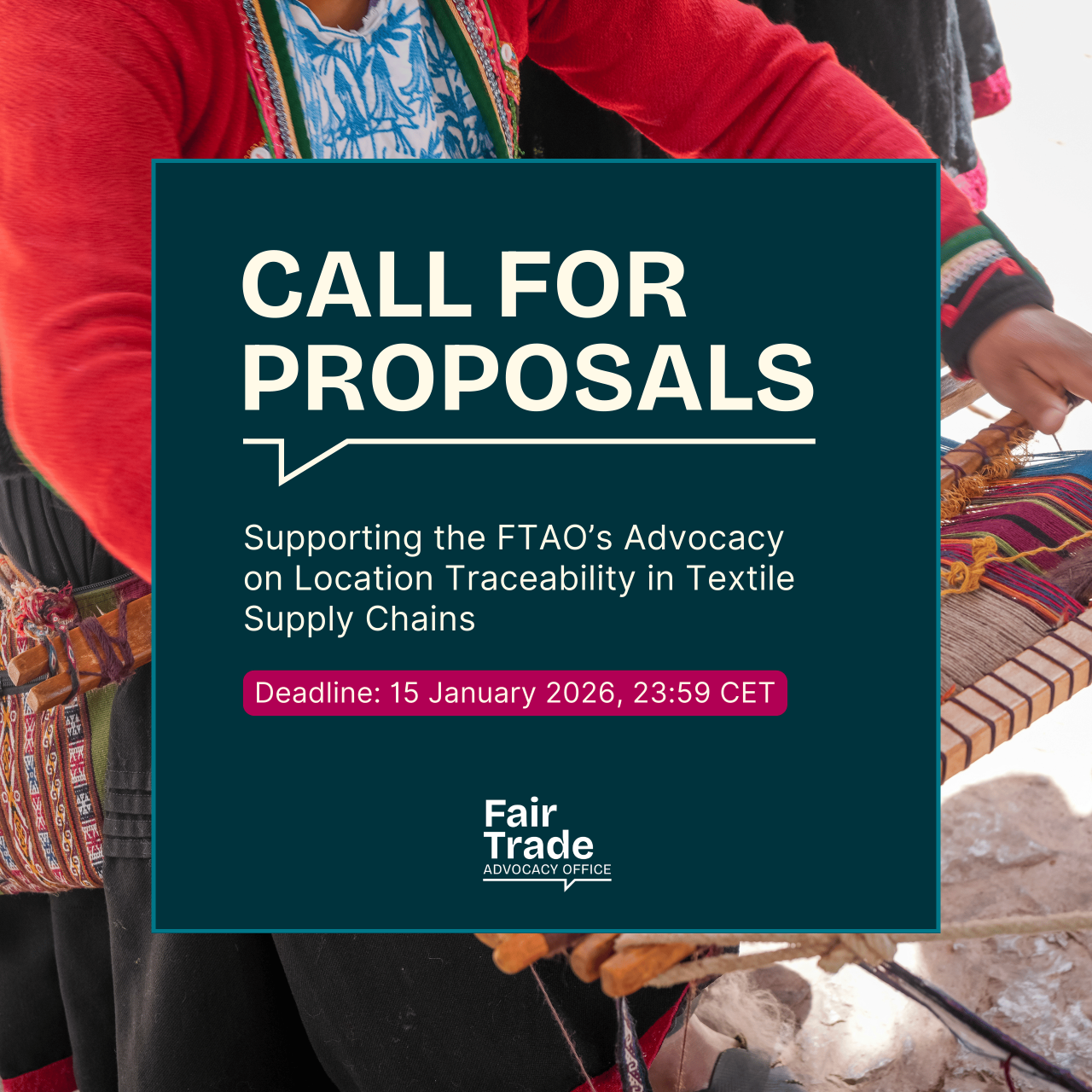
CALL FOR PROPOSALS: Supporting the FTAO’s Advocacy on Location Traceability in Textile Supply Chains
Budget: €13,000 (incl. VAT)
Final deliverable: End of March 2026
1) BACKGROUND
The Fair Trade Advocacy Office (FTAO) represents the Fair Trade Movement at the EU level and promotes justice, equity and sustainable development in global trade. Current EU reforms in textile policy – notably the revision of the Textile Labelling Regulation (TLR) and the development of the Digital Product Passport (DPP) under the Ecodesign for Sustainable Products Regulation – create a key opportunity to advance meaningful transparency in textile supply chains.
Revision of the Textile Labelling Regulation (TLR)
The TLR (EU No 1007/2011) is under revision. Article 24 of the current regulation requires the Commission to examine an origin-labelling scheme capable of providing “full traceability of textile products.” The revision is expected to introduce a digital component, allowing more detailed information via a QR code or similar mechanism. This digital label is anticipated to interact with, or be aligned with, the DPP system.
Digital Product Passport (DPP)
The DPP will become the EU’s main digital system for sharing sustainability and traceability information. A textile-specific delegated act will define required data fields, likely including location-based information on fibre production and subsequent processing stages.
Challenges and Opportunities
The FTAO sees challenges and opportunities, including potential trade-offs, in the development of requirements for more granular location disclosure. For example, increased granularity can raise privacy and data-protection considerations, especially when information could unintentionally identify individual farmers or small facilities. At the same time, insufficient granularity can undermine the system’s purpose: many environmental footprint indicators (e.g. water use, pesticide intensity, energy sources, etc.) and social indicators (living income reference prices, etc.) vary significantly by region, making more granular traceability essential for accurate environmental and social assessments. The project partner should analyse these trade-offs and propose options that balance meaningful transparency, environmental accuracy, and proportionality across diverse production contexts.
Why research is needed
As the Commission is due to publish its proposal for a revised Textile Labelling Regulation by April 2026, after which the European Parliament will negotiate it, and as the DPP technical requirements are being shaped, there is a pressing need for clear, evidence-based insights into:
- feasible and meaningful levels of granularity in location traceability (i.e. country, region, city, or precise production location);
- proportional and reliable approaches to identifying supply chain actors;
- best practices from real production contexts, including smallholder cotton regions;
- how traceability can provide visibility over social and environmental conditions throughout the supply chain.
This research will inform FTAO’s advocacy during these political and technical processes.
2) TASK OF THE PROJECT PARTNER
The project partner will conduct internal research to answer:
- Research question 1: Location Granularity
What levels of geographic and supply-chain granularity in location traceability would best provide actors in textile supply chains – especially organisations working with rightsholders – with useful and verifiable visibility over the social and environmental conditions of production, including up to farm level?
- Research question 2: Policy Requirements
Which EU policy requirements can most effectively support proportional, reliable location traceability across textile supply chains, enabling all actors to understand and share information about production conditions?
The FTAO is not seeking a technical proposal to design any traceability intervention. Rather, the outcome shall be policy-oriented and seek to identify workable ways that will contribute towards the FTAO’s objectives to promote transparency in the textile sector.
Expected outputs
- A research report for internal use addressing RQ1 and RQ2, including:
- comparative analysis of feasible granularity levels;
- analysis of identification and traceability approaches in use across textile supply chains, including
- assessments of trade-offs discussed above;
- examples of best practices, at least two from raw material level and two from factory level;
- concrete, actionable policy-relevant options that will contribute to the EU’s Strategy for Sustainable and Circular Textiles. - Annexes summarising interviews, focus groups, or other participatory methods (if undertaken).
No slide deck or graphic design is required. The internal report will not be directly published as is, and will guide the FTAO’s advocacy.
3. TIMELINE
- Expressions of interest deadline: 15 January 2026, 23:59 CET
- Project partner selected: Late January 2026
- Research period: ~8–9 weeks
- Final deliverables due: End of March 2026
The timeline is designed to align with European policy timelines.
4. METHODOLOGY AND PROCESS
Minimum requirement: desk research.
The FTAO strongly welcomes methodologies that include:
- Interviews with farmers, cooperatives, ginners, spinners, trade unions, worker organisations, certification bodies, or other supply-chain actors;
- Focus groups or participatory workshops in producer regions (where feasible within time and budget);
- Case studies grounded in real production contexts;
Proposals should demonstrate that insights will come from real conditions and rightsholders’ needs, ideally through fieldwork. If fieldwork is not possible, researchers must show how they will use other sources that accurately reflect field realities.
5. EXPRESSIONS OF INTEREST
Interested partners should submit:
- A brief description of the research team and key expertise;
- A proposed methodology and work plan, including length and level of depth of internal research report;
- A timeline showing the ability to meet the early April 2026 deadline;
- A budget consistent with the €13,000 limit (incl. VAT);
- Two examples of previous relevant work.
Send expressions of interest to kahle@fairtrade-advocacy.org
6. SELECTION CRITERIA
Submissions will be evaluated on:
- Relevant experience, including:
- direct work with smallholder farmers, cooperatives, or early-stage textile processors;
- practical familiarity with different tiers in textile manufacturing;
- knowledge of EU legislation, especially the TLR and textile-related DPP requirements. - Quality and suitability of the proposed methodology, including potential for participatory methods.
- Clarity and feasibility of the work plan and timeline.
- Proposed cost and compatibility with the project’s allocated budget (€13,000 incl. VAT).
- Alignment with the FTAO’s mission and values, including justice, equity, and sustainable development.
More From The Workstream

The FTAO launches Textiles Advocacy Strategy Group to strengthen global voices in EU textile policy
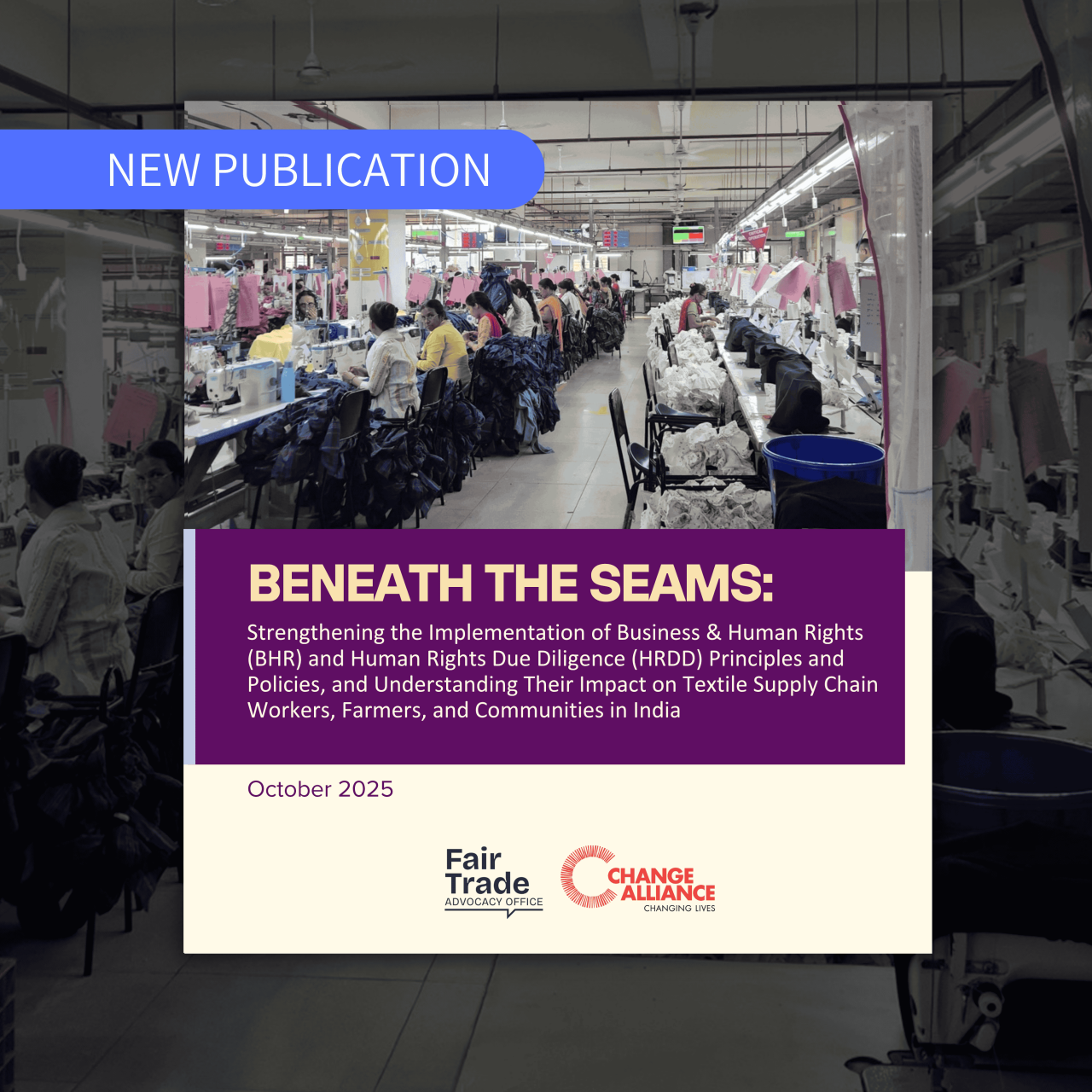
Beneath the Seams: Strengthening Human Rights Due Diligence and its impact on textile workers, farmers and communities in India
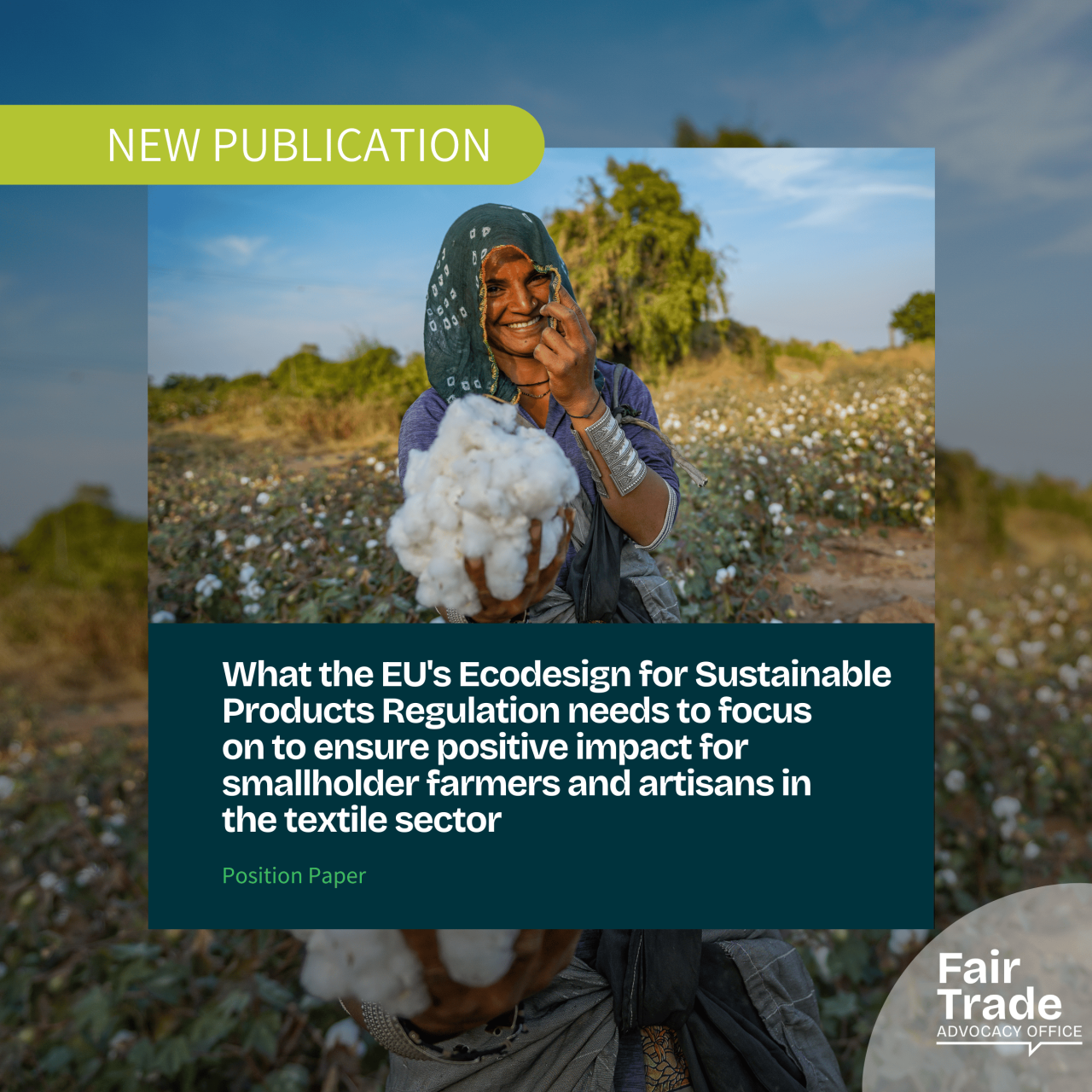
What the EU's Ecodesign for Sustainable Products Regulation needs to focus on to ensure positive impact for smallholder farmers and artisans in the textile sector