Trilogue deal on CSDDD is a step backwards for responsible business conduct
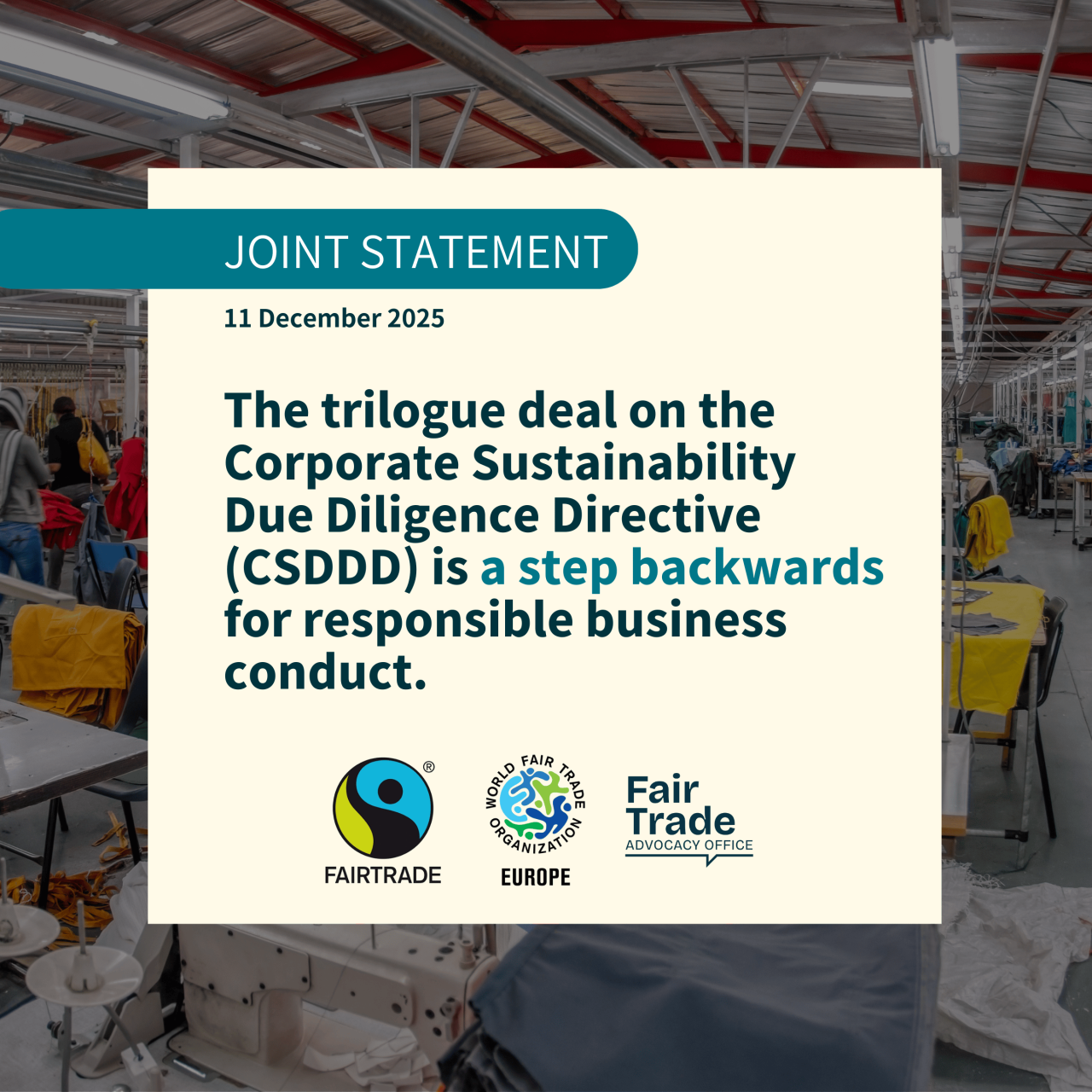
The agreed text weakens essential protections for smallholder farmers, workers, and responsible businesses. Further, its approach of placing key articles under a maximum harmonisation approach means that Member States cannot correct these weaknesses in national transposition, locking in a model of due diligence far below international standards.
The drastically narrowed scope limits the Directive to companies with over 5,000 employees and a €1.5 billion turnover, a mere estimated 1,341 companies across the EU. As a result, the vast majority of companies shaping global value chains will face no due diligence obligations at all. This is particularly alarming for sectors such as textiles, where 99.5% of companies are SMEs. Such exclusion contradicts the Directive’s original goal of levelling the playing field, leaves most abuses in value chains unaddressed, and penalises responsible companies that have already invested in due diligence.
- “Fair Trade enterprises have shown for decades that responsible business conduct is possible, practical and strengthens resilience. But this deal fails to create the level playing field responsible businesses need. When political leadership falls short, it is values-driven companies who carry the burden alone – while continuing to be undercut by businesses that put profits before people and planet.” Mikkel Kofod Nørgård, Regional Coordinator, WFTO-Europe.
The agreement fails to provide adequate safeguards against irresponsible disengagement. While suspension is still formally a last resort, and companies must assess the impact of suspension, essential safeguards from the original CSDDD, such as engagement with affected stakeholders before a buyer suspends a business relationship, have been removed. This omission is particularly harmful for smallholders and SMEs who often rely on a single buyer, cannot absorb sudden income losses, and face heightened risks of falling into poverty when disengagement is abrupt.
- “For smallholder farmers, this outcome offers far too little. Without meaningful dialogue with buyers and safeguards that prevent cut-and-run, farmers remain acutely vulnerable to sudden income loss and deeper poverty.” Meri Hyrske-Fischer, Senior Human Rights Advisor, Fairtrade International.
Despite early political promises to reduce burdens for SMEs, the trilogue deal introduces a structure that seems to ease requirements for smaller companies. However, by limiting companies’ ability to request information from business partners with fewer than 5,000 employees, the text risks blocking early identification of severe risks, including those related to living wages, living incomes, and purchasing practices. International standards such as the OECD Guidelines emphasise that due diligence requires iterative, collaborative engagement, not narrow or predetermined limitations that hinder communication with those most affected by adverse impacts.
- “Supply chains are under pressure. Farmers face droughts. Factory workers endure extreme heat. Yet incomes remain far from what’s needed for a decent living. With or without legislation, these issues are real. The EU has failed to seize the chance to help build a safety net, and sent a signal that reads: ‘You’re on your own.'” Alena Kahle, Senior Policy and Project Coordinator, Fair Trade Advocacy Office (FTAO).
While the trilogue negotiators did correct one major flaw by restoring a risk-based approach beyond direct suppliers, aligning with international standards, this improvement cannot compensate for the broader weakening of the Directive’s core provisions. The combined effect of a drastically reduced scope, restrictions on supplier engagement, weakened suspension safeguards, and a significantly delayed application timeline falls far short of what is needed to build resilient global value chains.
With today’s agreement, the Directive is now set to begin applying only in July 2029. This delay means that the protections intended for smallholders, workers, and responsible businesses will not come into effect for several years. Yet, this timeline does not reflect the urgency of supporting upstream suppliers, such as smallholder farmers, in addressing human rights and environmental risks.
The Fair Trade Movement will continue working with businesses, policymakers, and civil society to ensure that implementation reflects international standards of responsible business conduct. These practices remain essential for resilient business models and for protecting the millions of people whose livelihoods depend on global value chains - regardless of the limitations and delays built into this Directive. As the Directive now becomes law, the Fair Trade movement calls on:
- National policymakers to ensure that the critical shortcomings in stakeholder engagement and responsible disengagement are addressed during transposition;
- The European Commission to ensure that the upcoming guidelines for CSDDD implementation place collaboration and shared responsibility at the heart of due diligence, and are developed together with rightsholders and their representatives;
- The EU and its member states to prioritise providing financial and technical support to rightsholders and their representatives, vulnerable economic actors in global value chains (including smallholders and artisans) and to EU partner countries.
Contact
Alena Kahle, Senior Policy and Project Coordinator, Fair Trade Advocacy Office. kahle@fairtrade-advocacy.org
Meri Hyrske-Fischer, Senior Human Rights Advisor, Fairtrade International. meri.hyrske-fischer@fairtrade.fi
Mikkel Kofod Nørgård, Regional Coordinator, World Fair Trade Organization-Europe. coordination@wfto-europe.org
 (1).png)
.png)
More From The Workstream
The Fair Trade Movement’s recommendations for the revised Delegated Act on the European Sustainability Reporting Standards (ESRS)
29 CSOs call on the EU to protect the ambition of the ESRS and uphold strong standards for a resilient Europe
Guidelines for a Living Income: Fair recommendations for Living Income Guidance in the Corporate Sustainability Due Diligence Directive