The Fair Trade Movement welcomes amendments proposed by the European Commission to group certifications in the EU Organic Regulation

In its proposal, the Commission rightly recognises that inflation, rising certification costs and rigid eligibility criteria have made group certification increasingly inaccessible, particularly for smallholder organisations in third countries, as Fair Trade actors had been raising. These changes represent a significant step toward making organic farming more accessible for smallholder farmers and cooperatives worldwide.
According to the Commission’s proposal, the amendments will remove key barriers that have long hindered farmer organisations, including abolishing the maximum turnover thresholds for eligibility for group certification and removing the requirement for groups of operators to establish a separate legal personality. This would allow larger cooperatives and farmer organisations to organise organic certification through groups of operators embedded within existing cooperatives, without costly and artificial restructuring. Without these changes, key supply chains for products such as cocoa, coffee, fruit and spices risked fragmentation or exit from organic markets altogether.
From a Fair Trade perspective, the Commission’s response to the Herbaria ruling avoids abrupt trade disruption and preserves market access for producers in partner countries. At the same time, linking the use of the EU organic logo to additional conditions risks creating a two-tier organic regime if not carefully designed. Ensuring that equivalence remains meaningful will require proportionate implementation, full transparency in delegated acts, and adequate support for producers expected to adapt.
- “These changes go in the right direction and reflect concerns that the Fair Trade Movement and its members have consistently raised. For many smallholder farmers, complexity is not the only challenge, lack of support is. Simplifying the Organic Regulation will only work if it reduces unnecessary administrative burdens while preserving high standards and ensuring that smallholders are not left to absorb the costs alone.” Virginia Enssle, International and Institutional Relations Manager, Fair Trade Advocacy Office (FTAO).
- “Removing outdated turnover limits and legal entity requirements will reduce administrative burdens, lower certification costs and strengthen organic farming for smallholders, particularly in third countries. However, the response to the Herbaria ruling must be handled with care. Conditioning the use of the EU organic logo risks creating a two-tier organic market, especially where third-country logos are lacking or not recognised by consumers. The Commission’s 2026 follow-up must include safeguards to ensure equivalence remains meaningful and fair” Andreas Kratz, Director Global Products, Programs & Policy and Director Standards & Pricing, Fairtrade International.
Together, Fairtrade International and the FTAO have repeatedly warned that current rules create unnecessary barriers, increase integrity risks and undermine farmer organisations operating under national legal frameworks in partner countries. Maintaining the credibility of the EU organic logo and robust internal control systems remains essential. Simplification should strengthen, not weaken, trust in organic certification.
Further reform is needed
While welcoming the progress, the Fair Trade Movement stresses that additional reforms are needed to ensure that the EU Organic Regulation supports a genuine transition to organic farming. That is why the Fair Trade Movement also welcomes the Commission’s recently published roadmap to reduce the burden on organic operators and national administrations. The roadmap takes up several long-standing concerns raised by Fair Trade actors, including commitments to increase transparency around the high-risk product approach, simplify and accelerate procedures for authorised substances, and improve predictability in trade-related controls such as Certificates of Inspection. These steps respond to persistent calls from producer organisations for clearer, more workable rules that reduce unnecessary administrative burden without compromising integrity.
Together, the amendments and the roadmap signal a shift towards a more pragmatic and proportionate regulatory approach, better adapted to the realities faced by smallholder farmers and cooperatives, particularly in third countries. However, the Fair Trade movement continues to call for:
- Revisions to inspection and sampling rates for groups of operators, moving away from fixed quotas towards a risk-based approach that rewards well-functioning internal control systems;
- Clearer and more proportionate rules on residue findings and unauthorised substances, including predictable procedures and realistic laboratory requirements;
- Further flexibility in the implementation of the rules on the definition and composition of groups of operators, including clear recognition of operational units within larger cooperatives, in line with national laws;
- Further adjustments to size thresholds for organic holdings, which, despite the Commission’s suggested changes, still exclude many farmers for whom individual certification is not economically viable;
- Extended transition periods and continued recognition of third-country equivalence, including for the implementation of forthcoming delegated and implementing acts, to avoid disruption to supply chains and unnecessary exclusion of compliant producers.
- Targeted support and capacity-building for producer organisations, ensuring they have the technical, financial and institutional resources to adapt to regulatory changes and benefit from reforms.
Looking ahead
The Fair Trade Movement urges the European Parliament and Member States to swiftly adopt the Commission’s proposal and further calls on policymakers to ensure that the final amendments fully address the structural challenges faced by organic farmers and producer organisations, particularly in third countries supplying the EU market. In particular, the co-legislators should ensure that forthcoming delegated and implementing acts translate these improvements into proportional inspection practices and predictable enforcement.
Simplification must translate into real improvements on the ground. The success of the EU’s organic objectives depends on rules that are proportionate, predictable and adapted to the realities of farmer organisations worldwide.
Contact
Virginia Enssle, International and Institutional Relations Manager, Fair Trade Advocacy Office (FTAO), enssle@fairtrade-advocacy.org
Andreas Kratz, Director Global Products, Programs & Policy and Director Standards & Pricing, Fairtrade International, a.kratz@fairtrade.net
.png)
More From The Workstream
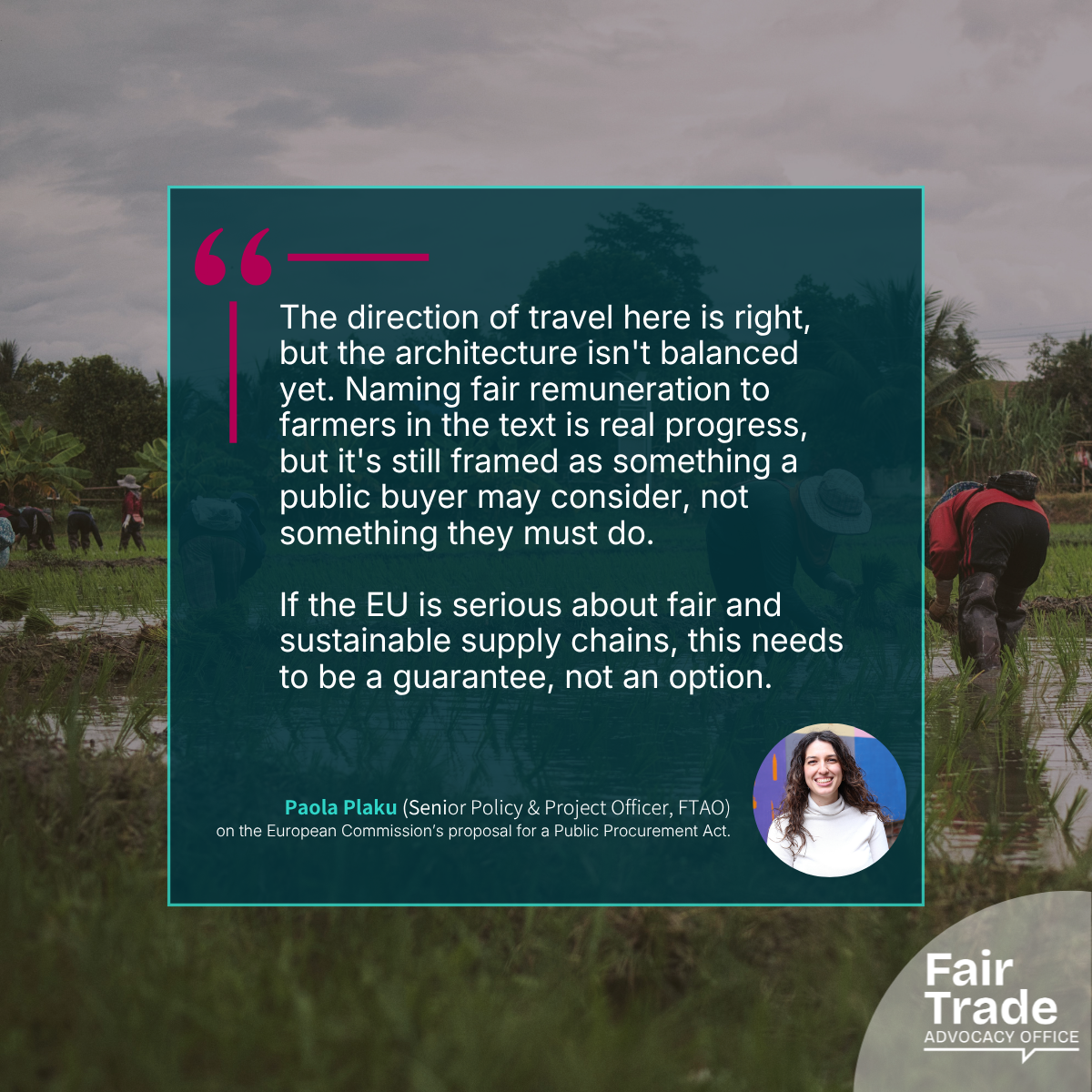
EU Public Procurement Act takes a step toward fairness, but legal guarantees are still missing

The revision of the EU’s rulebook for Public Procurement, a chance to deliver fairness
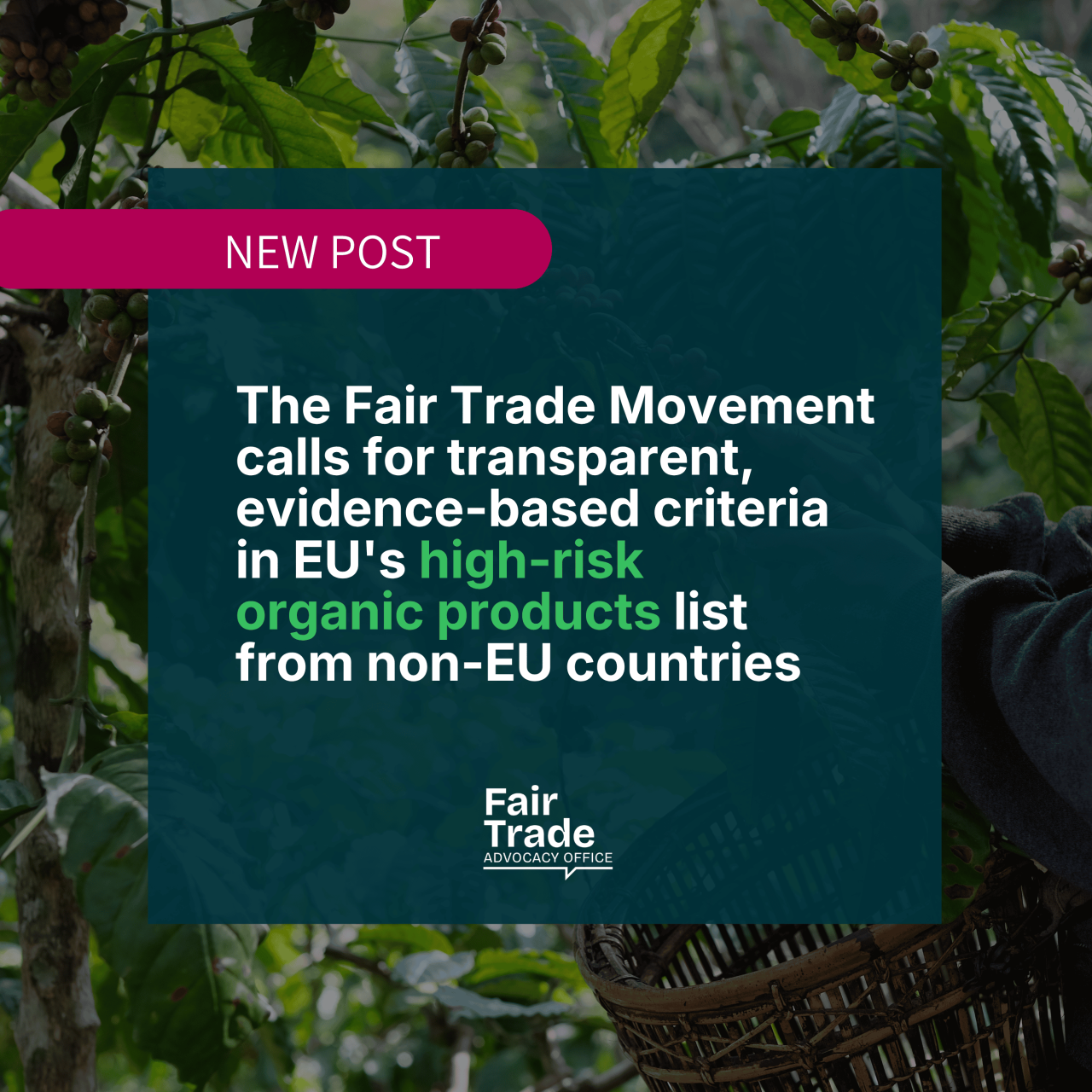
The Fair Trade Movement calls for transparent, evidence-based criteria in EU's high-risk organic products list from non-EU countries