Fair Trade Movement calls on EU to adopt a just, global phase-out of Highly Hazardous Pesticides
While the proposal aims to prevent the re-circulation of the most hazardous pesticides banned in the EU through imported goods, Fair Trade organisations warn that this measure unfairly shifts responsibility and costs onto farmers and workers in the Global South, without addressing the root cause: the continued export of the same Highly Hazardous Pesticides (HHPs) from the EU to third countries.
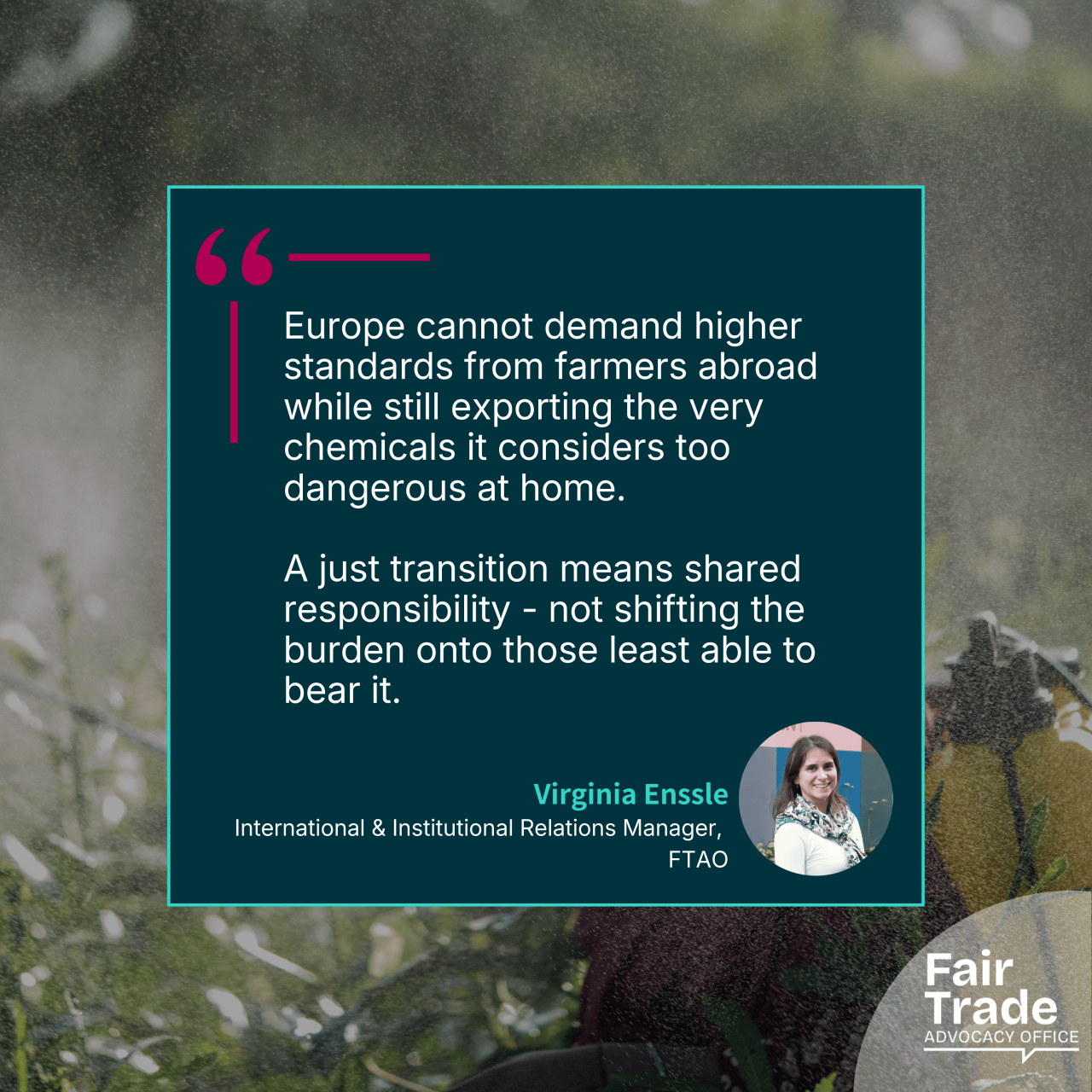
Europe cannot demand higher standards from farmers abroad while still exporting the very chemicals it considers too dangerous at home. A just transition means shared responsibility - not shifting the burden onto those least able to bear it.” Virginia Enssle, International and Institutional Relations Manager, Fair Trade Advocacy Office (FTAO).
A hazard-based import approach without global responsibility is unjust and ineffective
Smallholder farmers should not be punished for decisions made in Brussels, nor for hazardous chemicals that EU companies still export to their countries. An approach that tightens import residue requirements without parallel action on EU pesticide exports would disproportionately impact vulnerable small-scale farmers, increase the risk of income loss and exclusion from EU markets and undermine long-term poverty reduction and sustainability efforts.
The reduction in approved chemical active substances for use in plant protection products in the EU is necessary to protect human health and the environment. However, it must be accompanied by measures and safe solutions for farmers to protect crops against pests and climatic pressures that may not exist in the EU.
Fair Trade calls for a binding EU export ban with phase-out support
As reported by Public Eye, in 2024, EU Member States approved the export of almost 122,000 tonnes of pesticides whose use is banned on their own farms because of the dangers they pose to human health and the environment. A 50% increase from the data notified in 2018 and with 75% of these exports reaching low and middle-income countries.
Against this background, the Fair Trade Movement urges the EU to adopt a comprehensive, just transition approach, centred on:
- A binding export ban on all HHPs meeting EU hazard-based cut-off criteria
- A realistic, multi-year phase-out timeline;
- Dedicated financial and technical support for third countries to shift to safer pest management.
Support for agroecology and sustainable alternatives
Smallholder farmers should be supported in accessing alternatives, and so the FTAO welcomes the need to accelerate access to the market for new biocontrol and low-risk active substances and to support the shift to more sustainable plant protection practices. Solutions must also be made accessible to producers in third countries through technical assistance, knowledge sharing and international cooperation.
If the EU wants residues of HHPs eliminated from global supply chains, it must support the transition, not penalise producers. The Fair Trade Movement calls for substantial EU investment in:
- Agroecological practices and Integrated Pest Management;
- Research and field-level deployment of biological and low-risk alternatives;
- Training and extension services accessible to smallholders.
- This is particularly urgent for sectors such as banana production, where alternatives to HHPs like Mancozeb must be scaled up alongside the phase-out.
A shared responsibility for global sustainability
The Fair Trade Movement reiterates that sustainable pesticide reduction must be fair and coherent with EU development, human rights and trade commitments. The Commission should prioritise supporting EU and non-EU smallholder producers in shifting toward resilient, low-input farming systems that safeguard both crop yields and natural ecosystems.
Synthetic pesticides can be phased out. Agroecological and organic approaches, reinforced by strong IPM, are capable of sustaining production while enhancing biodiversity, soil quality and climate resilience - all essential for long-term food security.
The EU now has a chance to make sure that regulatory simplification is accompanied by strong safeguards and global transition measures, so that high protection standards do not result in unfair trade outcomes. While also considering that a full export ban on hazardous pesticides, accompanied by proper phase-out times and support for accessing alternatives, would be fairer and more effective in avoiding the production of these pesticides altogether.
The Fair Trade Movement stands ready to collaborate with EU institutions, producer organisations, and civil society partners to develop this and a monitoring that protects both human health and farmer livelihoods.
Get in touch
For more information, please contact Virginia Enssle, International and Institutional Manager at the FTAO, at enssle@fairtrade-advocacy.org
.png)
More From The Workstream
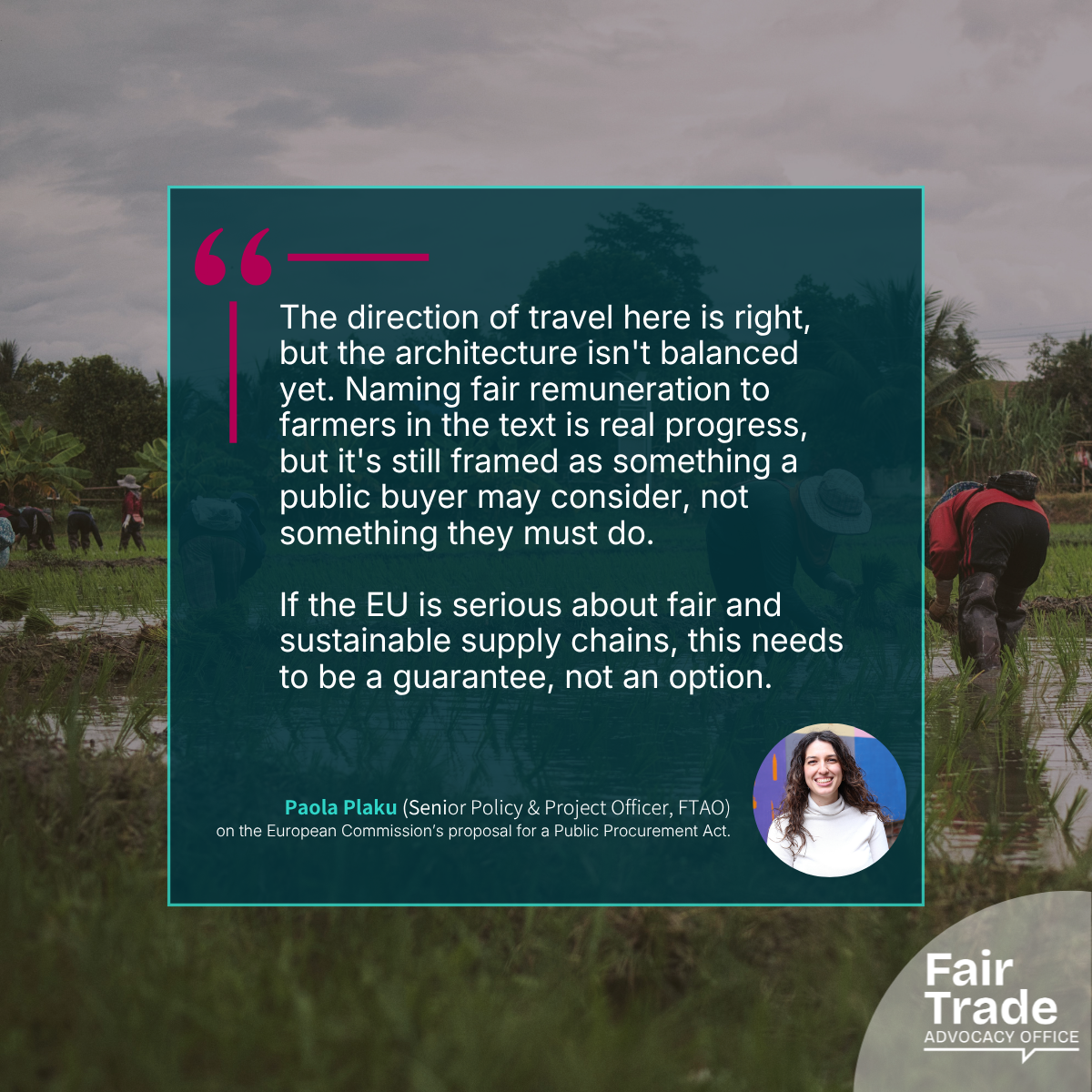
EU Public Procurement Act takes a step toward fairness, but legal guarantees are still missing
The revision of the EU’s rulebook for Public Procurement, a chance to deliver fairness
The Fair Trade Movement calls for transparent, evidence-based criteria in EU's high-risk organic products list from non-EU countries