The Fair Trade Movement’s feedback on the revision of the Public Procurement Directives
The upcoming revision of the EU public procurement framework is an opportunity to modernise European rules so they deliver better value for money, stronger transparency and greater economic resilience, while supporting Europe’s green, social and innovation objectives.
Today, public authorities in the European Union spend around €2 trillion per year (13.6% of GDP), yet less than 15% of above-threshold contracts currently qualify as “green”. And social criteria are used even less.
Consumer’s support for Fair Trade is strong: Fairtrade International’s 2025 survey shows 72% of consumers see a positive impact from buying Fair Trade, 40% buy Fairtrade monthly and 60% would pay a premium. Public procurement can reinforce this demand. Local authorities are already engaged, with 4,931 Fair Trade Towns initiatives in 27 countries, and results are visible, France saw 25% Fair Trade sales growth, and Oslo buys 80% Fairtrade bananas and 100% Fairtrade coffee.
However, Fair Trade Towns also report key barriers: political shifts, legal uncertainty, budget cuts, low awareness, insufficient capacity of public authorities. These challenges underscore why the EU must embed, not merely encourage, social and environmental objectives in procurement rules. The Fair Trade movement urges the Commission to address the following:
- Efficiency and transparency are best served when public procurement focuses on outcomes rather than procedures. Shifting from price-driven awards to value-based decision-making would resolve confusion around MEAT and over reliance on price. The revised rules should make MAT (Most Advantageous Tender) establishing the Best Price-Quality and Sustainability Ratio (BPQ&S) as the default award criterion for public contracts (Articles 67 and 72.6).
- Softening the strict interpretation of the “link to the subject matter” would allow contracting authorities to apply sustainability criteria more confidently, without undermining legal certainty.
- Fair Trade provides a practical and proven tool for delivering socially responsible procurement in this context. Credible Fair Trade labels offer independent, third-party verification of compliance with labour rights, living incomes, gender equality and environmental standards. This significantly reduces administrative and verification burdens for public buyers while increasing transparency across supply chains. Experience in several Member States shows that Fair Trade criteria can be applied in sectors such as food and textiles without increasing budgets once durability, reduced waste and life-cycle savings are taken into account.
- Resilient and transparent supply chains are also essential for Europe’s economic security. These objectives are better served by traceability and due-diligence-based requirements than by “buy European” approaches. Geographic preferences alone rarely deliver meaningful social impact. Any Buy European preference should be strictly linked to sustainability criteria.
- Procurement rules should reward fair, sustainable and diversified supply chains, supported by wider use of lot division, framework agreements and easier supplier consortia to strengthen SME participation.
- To make this approach workable in practice, the revised Directive should simplify procedures while strengthening strategic capacity. Clear permission to use social, human rights and Fair Trade criteria, supported by EU standardised model clauses, verification templates and expert support at Member State level, would reduce legal uncertainty for contracting authorities. Light, harmonised monitoring through eForms on indicators such as life-cycle savings, emissions reductions, SME participation and Fair Trade uptake would improve transparency and demonstrate the real long-term value of public spending.
- Simplification is key to uptake. Mandatory pre-market consultations for high-impact categories would improve tender design and avoid excluding SMEs and mission-driven enterprises. Joint and cross-border procurement should be facilitated through clear and uniform rules, allowing authorities to share due-diligence efforts and aggregate demand. Investment in training, shared tools and EU-level communities of practice would professionalise procurement while reducing administrative burden.
- Greater coherence is also needed between horizontal procurement rules and sectoral legislation. Food procurement, supplying tens of millions of meals daily, remains largely uncovered despite its strategic importance. Integrating minimum sustainability and Fair Trade requirements into developing sectoral food legislation would provide certainty for both buyers and suppliers. Italy’s Minimum Environmental Criteria (CAM – Criteri Ambientali Minimi) law and France's Egalim law show the way, with recognised Fairtrade and WFTO certifications and mandatory sustainability requirements. Good sources of inspirations to apply Fair Trade criteria come also from the recent JRC report on Food Public Procurement and the Buy Better Food manifesto.
- A practical step for the future Act would be reserving at least 5% of the annual value of public supply and service contracts for safeguarding high-risk and very-high-risk product segments from a human-rights and labour-rights perspective. These categories are already being used, for instance, in Norway, and by many large public buyers, and cover the most problematic sectors such as textiles, electronics, medical supplies, and fisheries. An EU-wide, centralised, risk-category database would be a major operational enabler. Most countries already do this analysis separately; consolidating it would reduce cost and increase legal certainty as Fair Trade products and services are mostly to be found in these high or very high risk categories.
Get in touch:
For more information about our work on Public Procurement, please reach out to Paola Plaku at plaku@fairtade-advocacy.org
More From The Workstream
Strengthening Socially Responsible Public Procurement Through Due Diligence: Lessons from EU Member States

Fair Trade Towns bring local action to the heart of the EU debate on public procurement
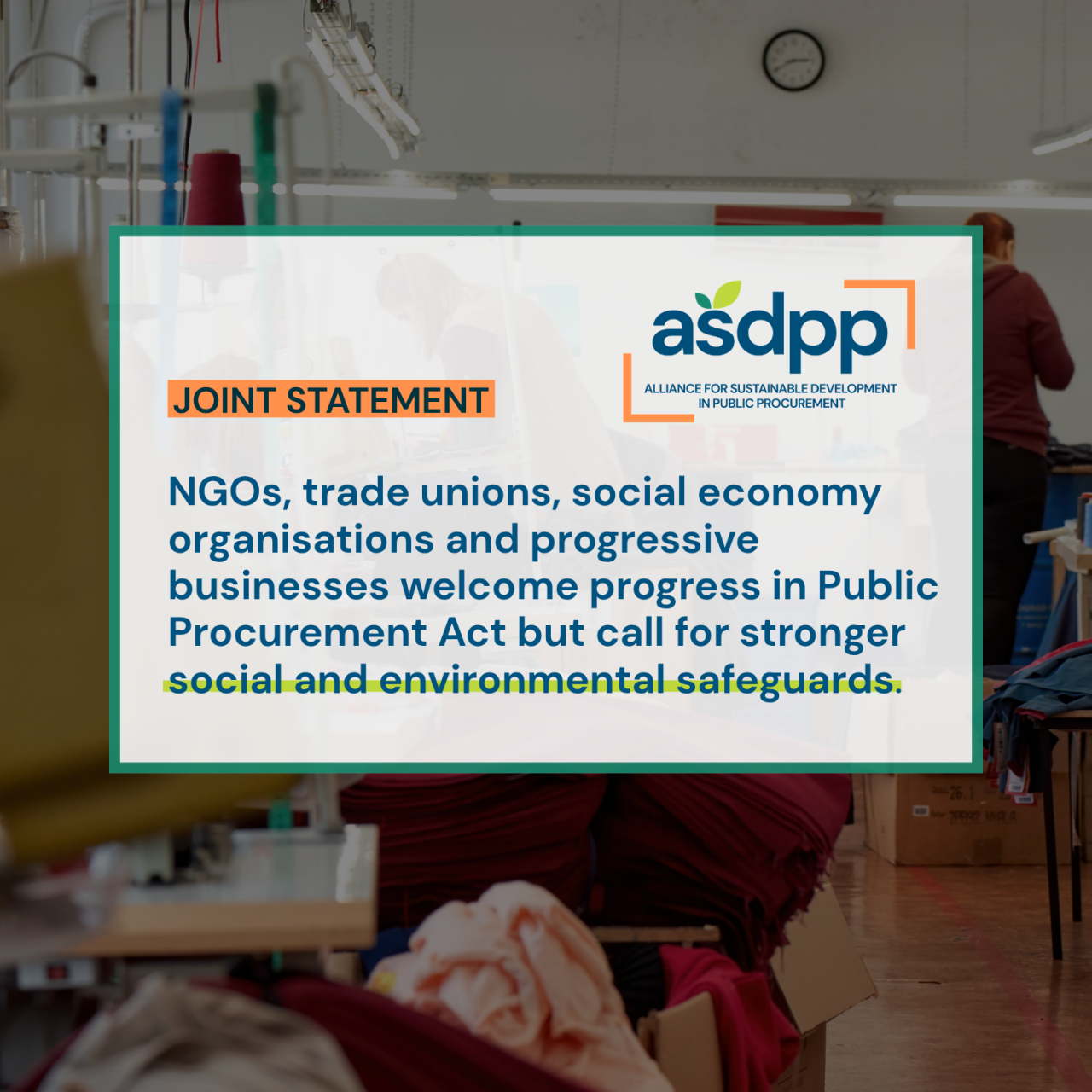
NGOs, trade unions, social economy organisations and progressive businesses welcome progress in Public Procurement Act but call for stronger social and environmental safeguards