What cotton farmers and artisans taught me: Reflections from the Organic Cotton Summit in Istanbul
By Alena Kahle, Senior Policy and Project Coordinator at the FTAO.
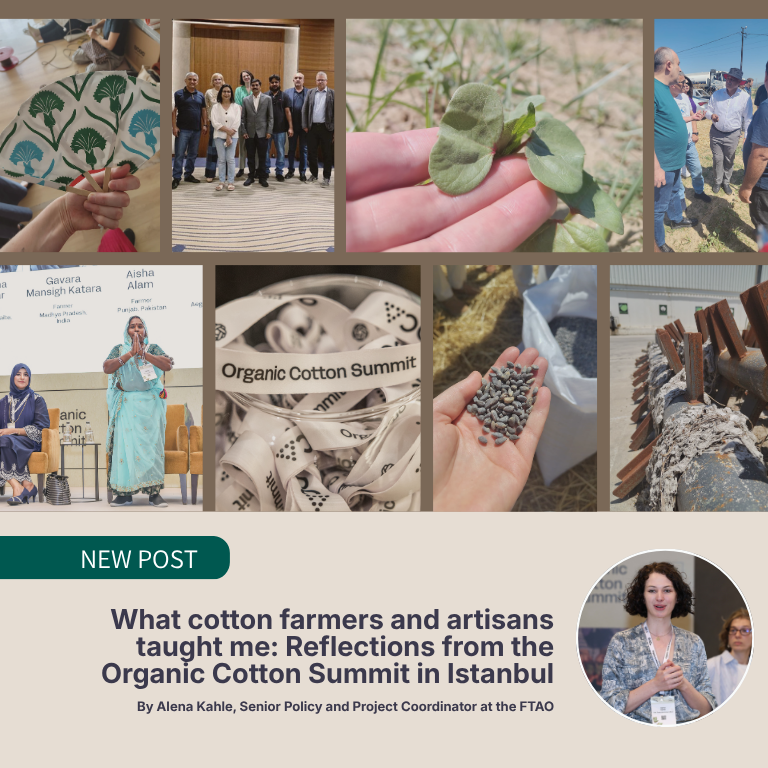
We were driving past olive groves and wheat fields, through hills that grew steeper by the kilometre. “Are you sure we’ll be able to see cotton fields?” the person next to me on the bus asked. We’d been travelling towards Aydın, in South-Western Türkiye, for about an hour, part of a field trip organised by the Organic Cotton Accelerator (OCA) and Textile Exchange as part of the Organic Cotton Summit that took place between 2-4 June in Istanbul, Türkiye. When the landscape changed, Assad Bajwa from Pakistan’s Fairtrade-cotton South Asia Sourcing began to stir with excitement. He had questions ready for Ali, the Turkish cotton farmer we were about to meet and Akasya, OCA’s local partner hosting the field visit, though he knew everyone else’s curiosity was just as insatiable.
The Organic Cotton Summit, gathered close to 270 participants from 24 countries, including smallholder farmers from across the world – Tajikistan, India, Pakistan, Brazil – and many more Fair Trade allies. These are precisely the people we advocate for in our advocacy towards the European Union. The farmers who nourish the soil, the workers who turn raw cotton into clothing at the cost of their own health, the artisans whose products are works of art.
Much of the Summit focused on how to capture the environment impact of cotton farming, and as we visited the fields in Aydın, the farmers themselves were most curious, huddling in discussions about yields, pest control, and soil testing. When dozens of ladybugs landed on our clothes, the farm’s contribution to biodiversity needed no data to prove itself. I kept thinking of the policy discussions in Brussels, where sustainability is often translated into numbers and reporting frameworks. Useful tools, but not ones that would have captured this. Later, in Istanbul, I visited the workshop of Sector7, a social enterprise where women artisans stitch, by hand, new garments from old hospital linen that would otherwise have been burnt. Over lunch, we puzzled over how a Digital Product Passport would capture that. I left feeling reinforced in the advocacy we’re already doing towards policy that rewards existing sustainable practices.
None of this was separate from social questions of money and power. Cotton farmers are among the poorest people in the world, receiving prices far below the cost of production, let alone sustainable production. One farmer representative told me: “Brands expect price-neutral sustainability”. While legislation such as the Corporate Sustainability Due Diligence Directive (CSDDD) expect shared responsibility, the textile sector has a long way to go. Ibrahim, a Turkish farmer, shared: “We haven’t gotten sufficient money in the last three years. If we don’t know what income we’ll have at the end of the year, we can’t plan and we don’t sow seeds.” As I walked the fields, I treaded carefully around the tiny saplings just beginning to sprout. An Indian producer beside me reminded me to watch my step. Each one would be worth around €5 once grown. Farmers are barely breaking even, yet buyers expect them to bear the costs of climate change adaptation on their own. One farmer representative told me: “Brands expect price-neutral sustainability.” Another told the crowd: “When there is crop failure due to climate change, the buyer doesn’t compensate, as they only pay for what they actually receive, even if it’s not the farmer’s fault.” It is clear that supply chain dynamics must change.
Izabela Erşahin, Vice Chair of the World Fair Trade Organization for Africa and the Middle East and social entrepreneur, welcomed me into her Istanbul workshop and insisted on how Fair Trade goes well beyond securing a living wage, it’s about how value is shared along the supply chain. “If a brand sells a jacket for €1,000, the people who contributed to it should get a fair share of that value,” she said, pulling up the pricing spreadsheet she shares openly with all her buyers. It was a quiet rebuttal to a common argument in EU policy and regulatory debates, that SMEs simply can’t afford to do due diligence properly. Here was one doing exactly that.
Across every conversation, the same phrases kept coming up: long-term relations, continued sourcing, equal partners. One farmer emphasised in conversation: “We don’t need to be beneficiaries of development, but equal partners.” The work of Linens for Life, which Izabela introduced, is an example of what that can look like: hotel chains pass their old linen to women refugees, who turn it into new products, and vice versa those hotels agree to become long-term repeat buyers.
Everyone I spoke with echoed a similar worry, that without effective legislation, the laggards will never catch up. On the bus back from the cotton fields, the sustainability manager of a luxury brand sitting next to me made this point, and others echoed support for EU sustainability legislation that we’ve worked on at the Fair Trade Advocacy Office. But as Suzana, a Brazilian cotton smallholder, reminded the room: what matters most is that the people these laws are meant to help are involved in shaping the rules. This is why we’re advocating for the Ecodesign Regulation, for instance, to be developed together with smallholder farmers and artisans, whose practices are precisely what the regulation seeks to support, and for implementation support to be co-designed with the actors it is meant to serve.
Get in touch:
For more information about our work on Fair & Sustainable Textiles, please contact our Senior Policy and Project Coordinator, Alena Kahle, at kahle@fairtrade-advocacy.org
More From The Workstream
Why the Digital Product Passport is (also) a public procurement story
The FTAO's feedback on the European Commission’s draft Implementing Regulation establishing the Digital Product Passport (DPP) registry
Recommendations for engagement with third-country actors on the ESPR Delegated Act for Textile Apparel